My name is Abdul Rehman Baig. I am expert in AI tools .I still remember sitting in my apartment at 11 PM, laptop open, googling “how to make money online” for probably the fourth time that month. I’d tried dropshipping. I’d tried Fiverr. I even half-heartedly attempted a print-on-demand store that made exactly zero sales. Nothing clicked.
Then I started playing around with AI tools mostly out of curiosity, not with any grand plan and within about three months, I had crossed the $1,000 mark. Not life-changing money, but real money. The kind that makes you think, okay, this is actually possible.
I’m going to walk you through exactly how I did it, including the dumb mistakes I made along the way, because I think those are more useful than a polished success story.
“I wasn’t chasing passive income or a get-rich-quick scheme. I was just trying to do something I was already doing faster and better.”

Where I started: freelance writing (with a twist)
I’d always been a decent writer. I used to do the occasional freelance piece for local blogs, mostly for peanuts. The problem was time a 1,000-word article that paid $40 would take me three hours. The math was brutal.
When I started using ChatGPT (and later Claude) as a drafting partner, my process changed completely. I wasn’t having AI write the articles for me that produced stuff that was generic and weirdly lifeless. Instead, I used it as a first-pass engine. I’d give it a brief, get a rough skeleton, then go in and rewrite everything with my actual voice, my examples, my experience.
That article that used to take three hours? I got it down to about 45 minutes. I went from delivering maybe 5 pieces a month to 18-20. That alone nearly quadrupled my writing income in the first two months.
The key shift: use AI to remove the blank-page problem and handle structural busywork. Keep your voice, your examples, your edits. Clients can feel the difference and they pay for it.
The tools I actually used
I’m not going to list 40 tools and pretend I used all of them. Here’s what genuinely mattered in my workflow:
Claude
Drafting, editing, brainstorming briefs
ChatGPT
Quick research outlines, headline ideas
Notion AI
Organizing client projects and briefs
Canva AI
Creating simple visuals for blog clients
Upwork
Finding writing & content clients
Grammarly
Final polish before delivery
The second stream: AI-assisted social media management
Around month two, a friend who runs a small skincare brand asked me to help with her Instagram. She was spending hours every week just thinking about what to post. I offered to do it for a flat monthly fee $150 and said I’d use AI to help with captions and content calendars.
It worked embarrassingly well. I’d use Claude to generate a month’s worth of caption drafts in one sitting, then edit them for her brand voice. What used to take her 8 hours a week took me 2 hours total. She was thrilled. I picked up two more clients like her within six weeks.
Three social media clients at $150/month = $450/month on top of the writing work. That’s when the $1,000 milestone started feeling close.

How I got those social media clients
Step 01
Start with someone you know
My first client was a friend. Don’t underestimate your existing network people who already trust you are the easiest first clients to get, even at a discounted rate to build your portfolio.
Step 02
Show the time-saving pitch, not the “AI” pitch
I never led with “I use AI.” I led with “I’ll save you 6 hours a week.” The outcome matters to clients. The tool is your business.
Step 03
Ask for referrals early
After a month, once your client is happy, just ask: “Do you know anyone else who struggles with this?” Three of my first five clients came from referrals.
Step 04
Create a simple one-page portfolio
Even a Notion page with three sample posts and a short bio works. It signals professionalism and makes it easy for clients to share your work with others.

The moment I almost gave up
Somewhere in month two, I had a client reject three rounds of revisions on an article. They said it felt “too AI-generated.” I was honestly devastated and a little defensive, because I thought I’d done a good job editing it.
But when I read it back with fresh eyes, they were right. I had gotten lazy. I’d kept too much of the AI’s structure, its filler phrases, its way of transitioning between ideas. It sounded technically fine but had no real personality.
That rejection taught me more than any tutorial. After that, I started being way more ruthless with edits. Every piece had to have at least one specific example, one opinion, one moment that sounded unmistakably like a human having a real thought.
The biggest mistake I see people make: submitting AI-drafted content with minimal editing and expecting clients to love it. AI is a starting point, not a finished product. If your clients can smell the robot, you’ll lose them.
How the money broke down across those first three months
For transparency here’s roughly how the $1,000+ came together:
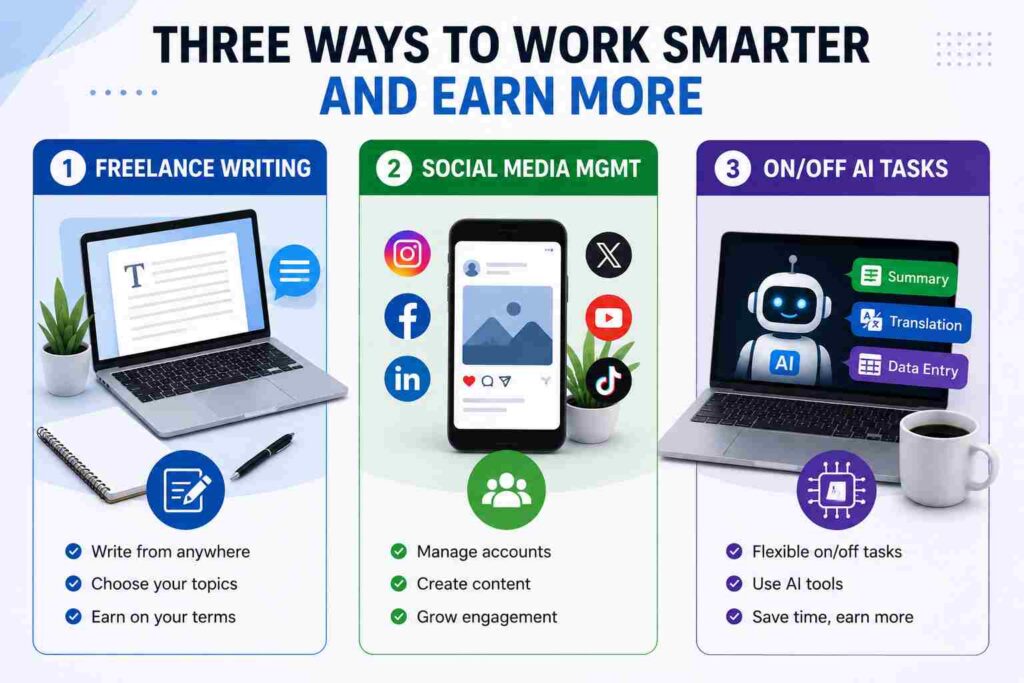
Freelance writing
~$580
Social media mgmt
~$450
One-off AI tasks
~$140
Total over ~12 weeks: just over $1,170. Not passive. Not effortless. But real and more importantly, repeatable.
What I’d do differently if I started over
I spent the first three weeks just experimenting with different AI tools without any clear goal. It felt productive, but it wasn’t. I should have picked one income stream on day one and gone all in on it. Exploration has its place, but it can become a comfortable form of procrastination.
I also underpriced myself early on. My first two writing clients paid me $30 per article. Once I started charging $75 $100, I actually got better clients who respected the work more. Pricing signals quality undercutting yourself doesn’t attract serious buyers, it attracts difficult ones.
And I wish I’d started building even a small audience earlier. A LinkedIn post I wrote about my process got 4,000 views and brought me two inbound client inquiries. I hadn’t expected that at all. Sharing what you’re learning, even casually, compounds faster than cold outreach.
A word on what AI can’t replace
I want to be honest about something: AI made me faster, but it didn’t make the hard parts easy. Finding clients is still sales. Delivering good work consistently is still discipline. Handling rejection, revisions, and scope creep none of that changed.
What AI gave me was more leverage on the hours I was already putting in. It’s a better hammer, not a magic wand. If you go in expecting to make money without effort, you’ll get frustrating results. If you go in thinking “how do I do what I already do, but faster?” that’s where the real opportunity is.
If you’re sitting where I was skeptical, a few failed attempts behind you, not sure if this is actually possible I get it. Just pick one thing. One client, one skill, one use case. The first $100 is harder than the second. The first $1,000 is harder than the next. But once you see it’s real, everything changes.

Pingback: AI side hustles that make money