Let me tell you something embarrassing.
The first time someone mentioned Python to me in the context of AI tools I nodded along like I knew what they were talking about and then went home and Googled “what is Python used for” like a complete beginner.
I have no technical background whatsoever. My degree is in English literature. My previous job was managing a small bookshop. The most technical thing I did regularly was updating the shop’s WordPress website and even that gave me occasional anxiety.
When AI tools started becoming genuinely useful around two years ago I assumed the opportunity was mostly for developers, data scientists, and people who understood what large language models actually meant beyond the surface level explanation.
I was completely wrong about that and it took me longer than it should have to figure it out.
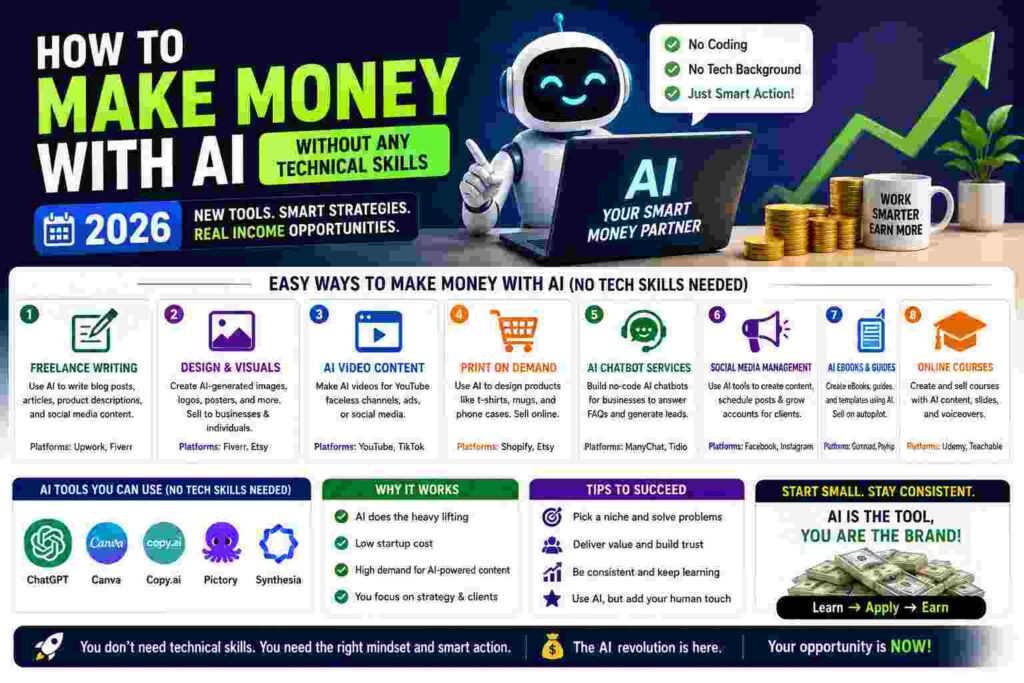
The honest truth is that the most valuable AI opportunities right now require zero coding, zero technical background, and zero understanding of how the technology actually works under the hood. What they require is clear thinking, good communication, and the willingness to learn interfaces that are genuinely designed for regular people.
This is what I figured out by doing it myself.
Why Technical Skills Are Not the Barrier People Think They Are
Here is something worth understanding about how AI tools are built right now.
The companies making these tools — Anthropic, OpenAI, Google, and the dozens of others competing in this space — are fighting intensely for regular consumer and business users. Not developers. Regular people. The interfaces are designed to be as accessible as possible because accessibility is a competitive advantage.
Using Claude, ChatGPT, Midjourney, or most of the AI business tools built on top of these models requires about the same level of technical skill as using Instagram or sending an email. You type, you click, you get results.
The technical complexity exists behind the scenes. You never see it and you never need to interact with it.
What separates people making money with these tools from people who are not is not technical knowledge. It is understanding what problems businesses and individuals need solved, knowing which tools address those problems, and being able to deliver results consistently and professionally.
Those are people skills, not technical skills.
The AI Money Opportunities That Require Zero Technical Background
Let me get specific because vague encouragement does not help anyone.
AI Assisted Content Writing
This is the most accessible entry point and I say that as someone who started here.
Businesses of every size need consistent written content — blog posts, email newsletters, social media captions, website copy, product descriptions. Most business owners either do not enjoy writing or do not have time for it.
AI tools make it possible for someone with strong language instincts and good editing judgment to produce high quality content significantly faster than before. You are not pressing a button and submitting whatever comes out. You are using AI to accelerate research, generate structure and drafts, then applying your own judgment and voice to shape the final product into something genuinely good.
I started offering this service at $35 per blog post on Fiverr. Eighteen months later I was charging $150 to $200 per post with a client waitlist. The technical skill involved at any point in that journey was exactly zero. The skills that mattered were understanding what made content good, communicating clearly with clients, and consistently delivering work people were happy with.

Social Media Content Packages
Every business with a social media presence has the same problem. They know they should be posting consistently. They never have enough time or ideas to actually do it.
Offering a monthly package of social media content — thirty captions for Instagram, a week of LinkedIn posts, a month of Twitter content — is something you can deliver efficiently with AI assistance once you understand a client’s brand voice and audience.
The setup for this service involves no technical knowledge. You learn what the client does, who their audience is, and what tone they want. You use AI to generate content ideas and drafts. You edit and refine everything to match the brand. You deliver a polished package.
I have seen people charge anywhere from $150 to $500 per month for this service depending on platform count, posting frequency, and client size. The recurring nature of it means stable monthly income once you have a few clients.
AI Chatbot Setup for Small Businesses
This one surprises people because it sounds more technical than it is.
Platforms like Tidio, Chatbase, and ManyChat have been specifically built so that non-technical people can create and deploy functional AI chatbots. The interfaces look like document editors. You type in the information you want the chatbot to know, set up the conversation flows using drag and drop tools, and connect it to a website using a simple embed code that the platform generates for you automatically.
I learned to do this in a weekend using free YouTube tutorials. My first chatbot client paid me $350 for a setup that took me about five hours including the learning curve. The second took three hours. By the fifth I had a clear process and was completing setups in under two hours.
Small businesses pay for this because having someone else figure it out saves them the confusion and time even if the actual task is straightforward once you know the tools.
AI Image Creation for Product and Marketing Use
Midjourney, Adobe Firefly, and DALL-E have created a real market for people who can reliably produce professional looking AI generated images for business use.
The skill here is not technical. It is learning how to write prompts that produce the specific style, mood, and content a client needs. This takes practice and a good visual eye more than any technical knowledge.
Etsy sellers need product mockup images. Coaches and consultants need social media graphics. Bloggers need featured images. Local businesses need marketing visuals. The demand for affordable custom visuals is enormous and growing.
People sell individual AI image sets on platforms like Fiverr for $30 to $150 depending on quantity and commercial usage rights.
AI Powered Virtual Assistant Services
Traditional virtual assistant work involves calendar management, email sorting, research tasks, travel booking, and administrative support. AI tools have made it possible to handle a much larger client load than before because research tasks that used to take an hour take fifteen minutes, drafts that used to take forty-five minutes take ten.
You are not replacing yourself with AI. You are using AI to become a more efficient, higher capacity version of yourself and charging for the results you deliver rather than the hours you work.
Virtual assistant services with AI assistance typically charge $25 to $60 per hour or flat monthly retainer fees of $400 to $1,500 depending on scope.
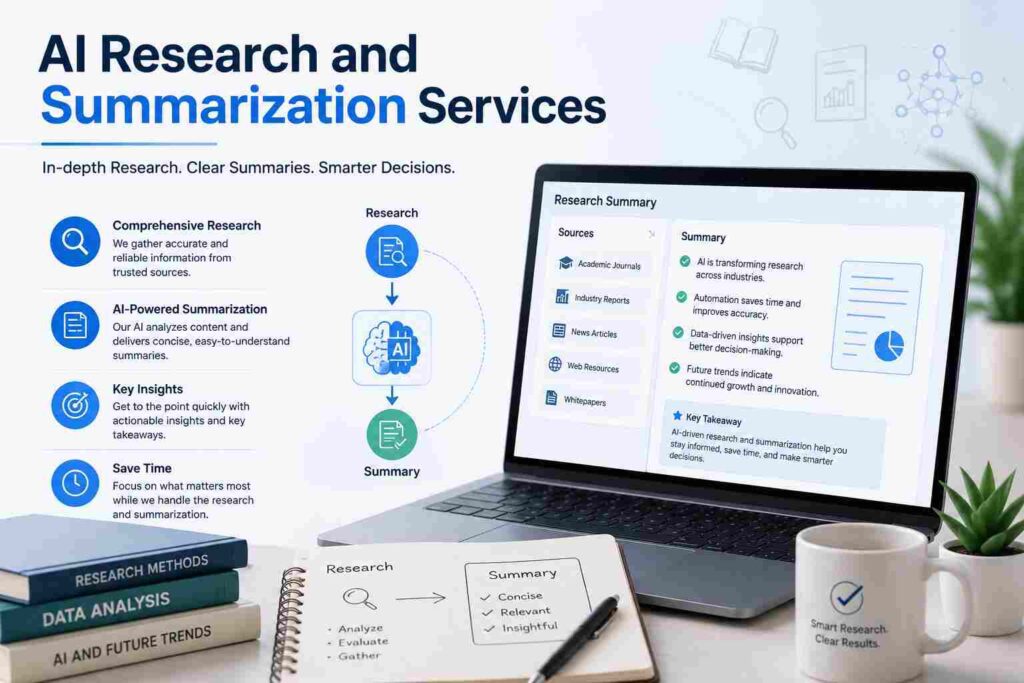
AI Research and Summarization Services
Busy professionals — executives, investors, consultants, academics — regularly need information synthesized and summarized from large volumes of material. Industry reports, competitor analyses, literature reviews, market research.
AI tools are extraordinarily good at processing and summarizing large amounts of text. A skilled human still needs to frame the right questions, verify accuracy, and present findings in a format that serves the specific audience. But the raw research capacity AI provides makes this service dramatically more scalable.
Offering research packages to professionals and small businesses is a genuinely viable income stream that requires no technical knowledge — just strong research instincts, clear communication, and careful fact-checking habits.
Step by Step Getting Started With No Technical Background
Step 1: Pick one service to start with
The biggest mistake beginners make is trying to offer everything at once. Pick the one service from the list above that most closely matches skills you already have. Strong writer — content writing. Organized and detail oriented — virtual assistant. Creative eye — AI image creation. Do not try to learn multiple services simultaneously.
Step 2: Spend two weeks learning the tools for that specific service
You do not need courses for most of this. YouTube has comprehensive free tutorials for every tool mentioned in this article. Search specifically for beginner tutorials and spend focused time actually using the tools rather than just watching videos about them. Doing beats watching every time.
Step 3: Build two or three portfolio samples before pitching anyone
Create fictional examples of your work. A sample blog post for an imaginary company. A social media content pack for a pretend coffee shop. A chatbot demo for a fictional dental practice. These samples prove you can deliver without requiring a real client to take a risk on you first.
Step 4: Set up a simple profile on Fiverr or Upwork
You do not need a website to start. A well-written profile on either platform is enough to land first clients. Be specific about what you offer, who it is for, and what outcome the client gets. Use your portfolio samples as examples of your work.
Step 5: Price lower than feels comfortable for your first five clients
The goal of your first few clients is reviews and case studies, not income optimization. A lower price point gets you in the door, gets you real projects to learn from, and builds the social proof that justifies higher rates later. Plan to raise your prices after you have five solid positive reviews.
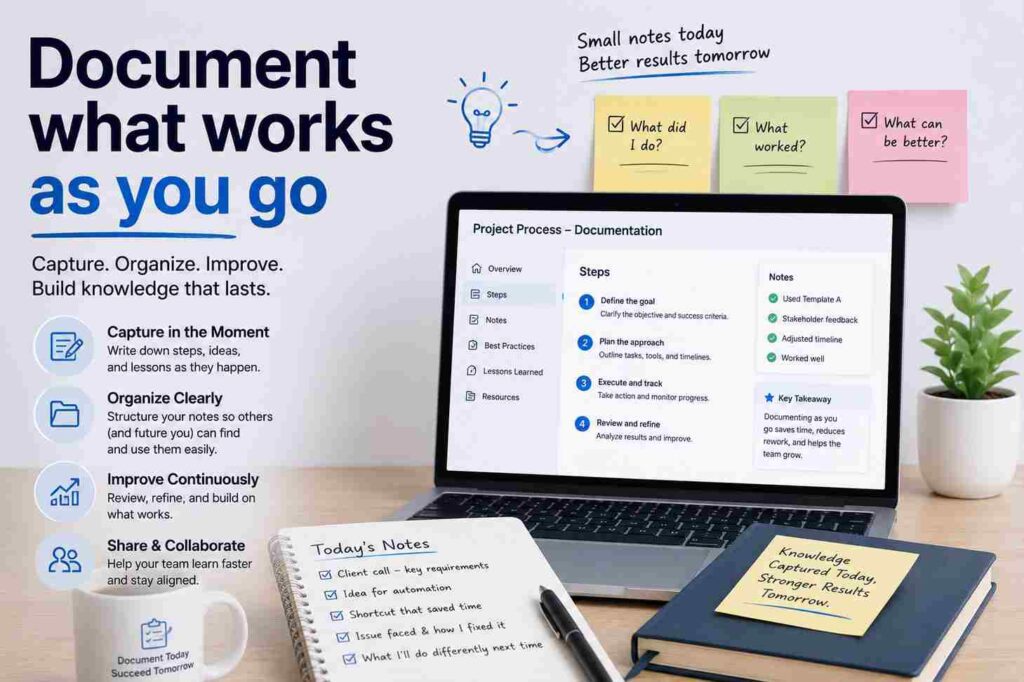
Step 6: Document what works as you go
Every efficient prompt you develop, every workflow that saves you time, every client communication approach that leads to happy outcomes — write it down. You are building a personal operating system for your service. After six months this documentation becomes an asset that makes you dramatically faster and more consistent than when you started.
Real Mistakes I Made That You Can Avoid
Spending too much time learning and not enough time doing. I watched probably forty hours of YouTube tutorials about AI tools in my first month before I had done a single real project. The learning that actually stuck happened when I was doing real work for real people under mild pressure to deliver something good.
Being vague about what I offered. My first Fiverr profile said something like “I help businesses with content and AI tools.” That is meaningless. Nobody knows what to hire you for. Being specific — “I write SEO optimized blog posts for health and wellness brands, 800 to 1500 words, delivered in 48 hours” — gets you actual clients.
Not editing AI output carefully enough early on. I submitted a few pieces of work in my first month that were too close to raw AI output and clients noticed. One left a three star review that set me back significantly. After that I built a personal editing checklist that I run through every single deliverable before sending.
Underestimating how much client communication matters. The quality of your actual work is only part of what clients are paying for. How responsive you are, how clearly you communicate about timeline and scope, how gracefully you handle revision requests — these things determine whether a client comes back and whether they refer others. I improved my income more by improving my client communication than by improving my technical AI skills.
Trying to hide that I used AI tools. Early on I was nervous about clients knowing I used AI assistance. When I started being straightforward about it — explaining that I use AI tools as part of my research and drafting process but that all final work reflects my own judgment and editing — clients responded better than I expected. Transparency builds more trust than vague professionalism.
What Nobody Tells You About the Learning Curve
The first month feels harder than it actually is.
There is a lot of uncertainty at the beginning — which tools to use, whether your work is good enough, whether anyone will hire you, whether you are doing this right. That uncertainty is uncomfortable but it is temporary.
By month two most people have found a workflow that feels manageable. By month three the service they chose starts feeling genuinely natural. By month six the question has usually shifted from whether this works to how to grow it.
The technical barrier that seemed intimidating from the outside turns out to be almost nonexistent once you are actually inside the tools. They are designed for you. The companies building them spent enormous resources making sure someone with no technical background could use them effectively.
What actually determines success at this is not anything technical. It is the willingness to start before you feel ready, to deliver good work consistently even when you are still learning, and to treat every early client as an opportunity to get better rather than just an invoice to collect.
Those are things you already know how to do.
Income results vary significantly based on effort, consistency, niche choice, and individual circumstances. Nothing in this article guarantees specific earnings. All freelancing and service businesses involve real work and real learning curves.