About a year ago I watched a colleague submit an AI-generated report to our manager that was so generic and surface-level it was almost painful to read.
Same week, another person on the team submitted something completely different — nuanced, specific, structured exactly the way our manager liked it, with data framed in a way that actually told a story. Also AI-assisted. Also generated in a fraction of the time a manual report would take.
Same tool. Completely different results.
I asked the second person what they did differently. They pulled up their screen and showed me the prompt they’d used. It was three paragraphs long, packed with context, specific instructions about tone and structure, examples of what good looked like, and explicit instructions about what to avoid.
I looked at my own prompts from that week. They were one or two sentences. Vague. No context. No direction.
That moment reframed everything I thought I understood about AI tools. The tool wasn’t the variable. The prompting was.
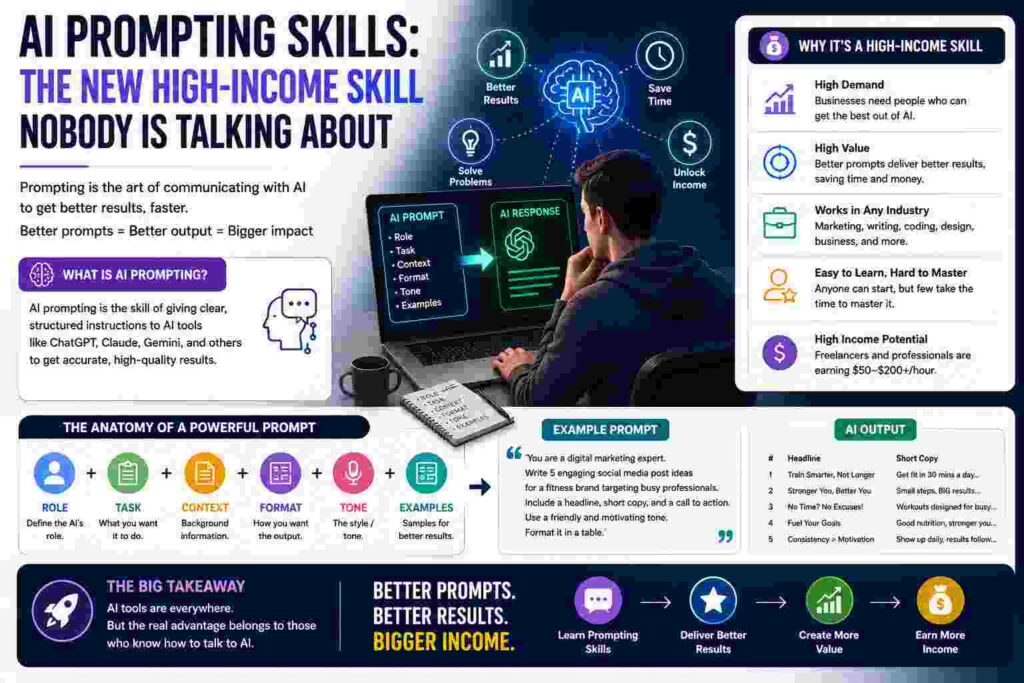
Why Most People Get Mediocre Results From AI
Here is the uncomfortable truth that the people selling AI courses don’t emphasize enough.
The majority of people using AI tools are getting mediocre outputs because they’re asking mediocre questions. They type a vague request, get a generic response, decide AI isn’t that impressive, and move on.
What they’re actually experiencing isn’t a limitation of the technology. It’s a limitation of how they’re communicating with it.
Think about it like hiring a contractor for your home. If you call them and say “fix the house” you’ll get whatever they think is most obvious, which probably isn’t what you actually wanted. If you call them and say “replace the cracked tile in the upstairs bathroom, match the existing cream-colored grout, and finish by Thursday because we have guests arriving” — now they can actually deliver what you need.
AI works the same way. The quality of what comes out is almost entirely determined by the quality of what goes in.
And here’s why this matters financially — the people who genuinely understand how to communicate with AI tools are delivering dramatically better work, faster, and charging accordingly. Prompting has quietly become one of the most valuable workplace skills of the last two years.
What Prompt Engineering Actually Means in Practice
The term “prompt engineering” sounds technical and intimidating. It isn’t.
At its core it just means learning how to structure your requests to AI in a way that reliably produces useful, high-quality output. No coding required. No technical background needed. Just understanding a handful of principles and practicing them consistently.
Let me break down the elements that actually matter.
Context Is Everything
The single biggest improvement most people can make immediately is adding context to their prompts.
Instead of: “Write a product description for my coffee maker.”
Try: “Write a product description for a premium pour-over coffee maker targeting specialty coffee enthusiasts who care deeply about extraction temperature and brew time precision. The tone should be knowledgeable but not snobby. The buyer is typically 28 to 45, values craft over convenience, and is willing to pay more for quality. Keep it under 150 words and end with a subtle call to action.”
The second prompt gives the AI everything it needs to make real decisions about tone, audience, length, and angle. The output is incomparably better.
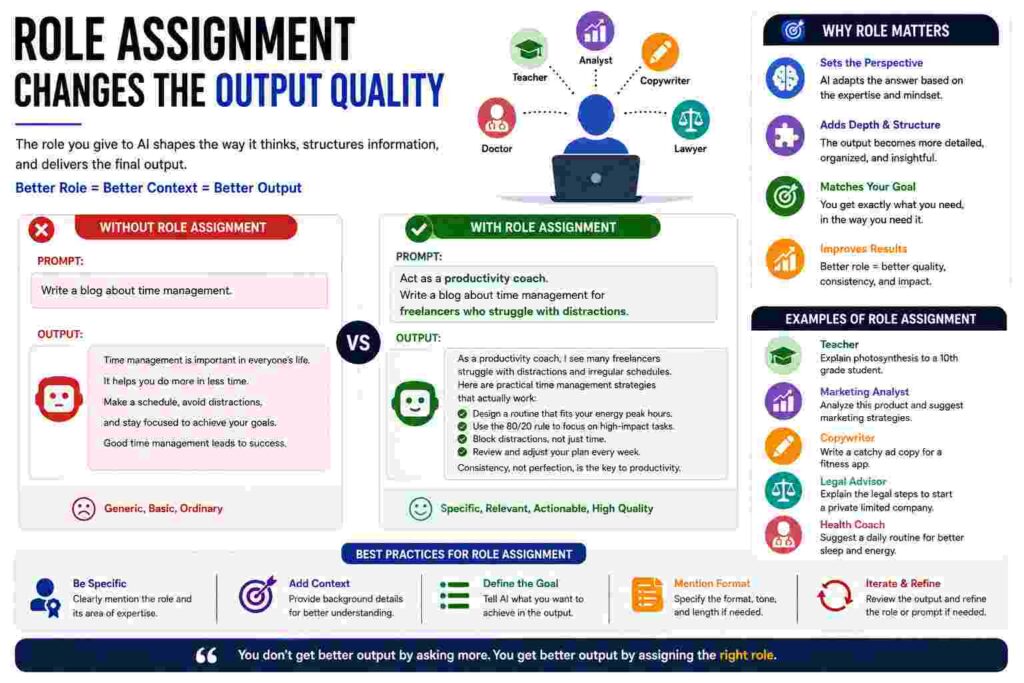
Role Assignment Changes the Output Quality
One of the most consistently useful prompting techniques is telling the AI what role to take before asking it to do anything.
“You are an experienced financial advisor specializing in tax strategy for self-employed individuals. Explain the top three tax deductions most freelancers miss.”
Versus simply: “What tax deductions do freelancers miss?”
The role-assigned version produces responses that feel more authoritative, more specific, and more genuinely useful. The AI draws on different patterns when it has a clear role versus when it’s answering as a generic assistant.
I use this constantly. Before any complex task I spend thirty seconds thinking about what kind of expert would be best positioned to answer this question, then assign that role explicitly.
Specifying Format Saves Enormous Amounts of Editing Time
Most people get AI output and then spend time reformatting it into what they actually needed. This is completely avoidable.
Tell the AI exactly what format you want upfront. Number of sections, approximate length for each, whether you want bullet points or prose, whether you want headers, whether you want a summary at the end, what to avoid including.
“Structure this as five short paragraphs, no headers, conversational tone, under 400 words total, avoid jargon, do not use the phrases in conclusion or in summary.”
Specifying format upfront means the output lands close to usable immediately rather than requiring significant reshaping.
Examples Are More Powerful Than Descriptions
Describing what you want in the abstract is weaker than showing an example of it.
If you want AI to write in a specific style, include a sample of that style in the prompt. “Write in a tone similar to this example: [paste example].” The AI will match that style more accurately than if you tried to describe it with adjectives.
I use this when writing content for clients who have an established brand voice. I’ll paste two or three examples of their existing content into the prompt and ask the AI to match that voice. The results require far less editing than when I tried to describe the voice in abstract terms.
Chain of Thought for Complex Tasks
For anything analytical or multi-step, asking the AI to think through its reasoning before giving a final answer consistently produces better results.
Add phrases like “think through this step by step before answering” or “explain your reasoning as you work through this” to the prompt. This forces a more methodical approach and surfaces reasoning you can check rather than just conclusions you have to trust blindly.
How This Becomes a Real Income Skill
Understanding prompting deeply creates income opportunities in several distinct ways.
Delivering better freelance work faster. Every service you offer — writing, research, analysis, design briefs, marketing strategy — improves in quality and speed when your prompting is genuinely good. This directly supports charging higher rates and taking on more volume without working more hours.
Selling prompting as a service. There is a real and growing market for people who will build custom prompt libraries for businesses. A law firm that wants to use AI for client communications needs prompts tailored to legal language and appropriate disclaimers. A real estate agency wants prompts that produce property descriptions in their specific style. These are specific, valuable, paid engagements.
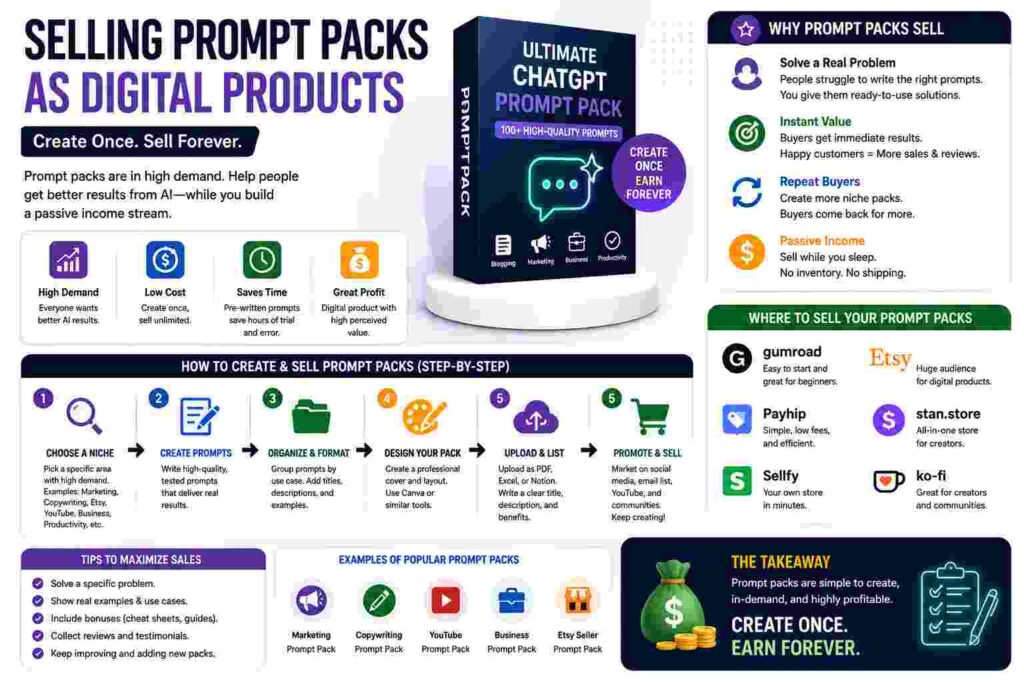
Selling prompt packs as digital products. Platforms like Gumroad, Etsy, and PromptBase have active marketplaces for prompt collections. A well-curated pack of fifty prompts for a specific use case — social media content for restaurants, email sequences for coaches, product descriptions for e-commerce sellers — sells repeatedly with zero ongoing effort after creation.
Training and consulting. As businesses try to implement AI into their operations, many of them need someone to teach their teams how to actually use these tools effectively. A half-day workshop on practical prompting for a business team of fifteen people is a real and growing consulting opportunity.
Internal value that leads to raises and promotions. Not everything has to be a side hustle. Being the person on your team who consistently produces the best AI-assisted work, who helps colleagues get better results, who builds the prompt templates your whole department uses — that visible expertise has career value even if you never freelance a single day.
Step-by-Step: How to Actually Develop This Skill
Step 1: Start documenting your prompts immediately
Every time you write a prompt that produces genuinely good output, save it. Build a personal library in Notion, a Google Doc, or even a simple text file. Most people treat good prompts as throwaway moments. The people building real expertise treat them as assets to be refined and reused.
Step 2: Practice the before and after exercise
Take a task you’d normally do yourself — writing an email, summarizing a document, analyzing options — and try three different prompts for the same task. Compare the outputs. Notice what changed between a vague prompt and a detailed one. This exercise builds prompting intuition faster than any course.
Step 3: Learn the four core prompting frameworks
These four structures cover the vast majority of practical prompting situations.
ROLE plus TASK plus FORMAT plus CONSTRAINTS. Assign a role, describe the task, specify the output format, and set the constraints like length, tone, what to avoid.
CONTEXT plus PROBLEM plus QUESTION. Give background information, describe the specific problem, then ask your question. Works well for analytical and advisory prompts.
EXAMPLE plus INSTRUCTION. Show an example of what good looks like, then give your instruction. Best for style matching and format replication.
STEP BY STEP. Ask the AI to approach the task step by step before producing a final answer. Best for complex reasoning tasks.
Step 4: Practice across multiple AI tools
Claude, ChatGPT, Gemini, and Perplexity each have slightly different strengths and respond differently to the same prompts. Spending time with multiple tools teaches you nuances that make you more versatile and gives you better judgment about which tool to use for which task.
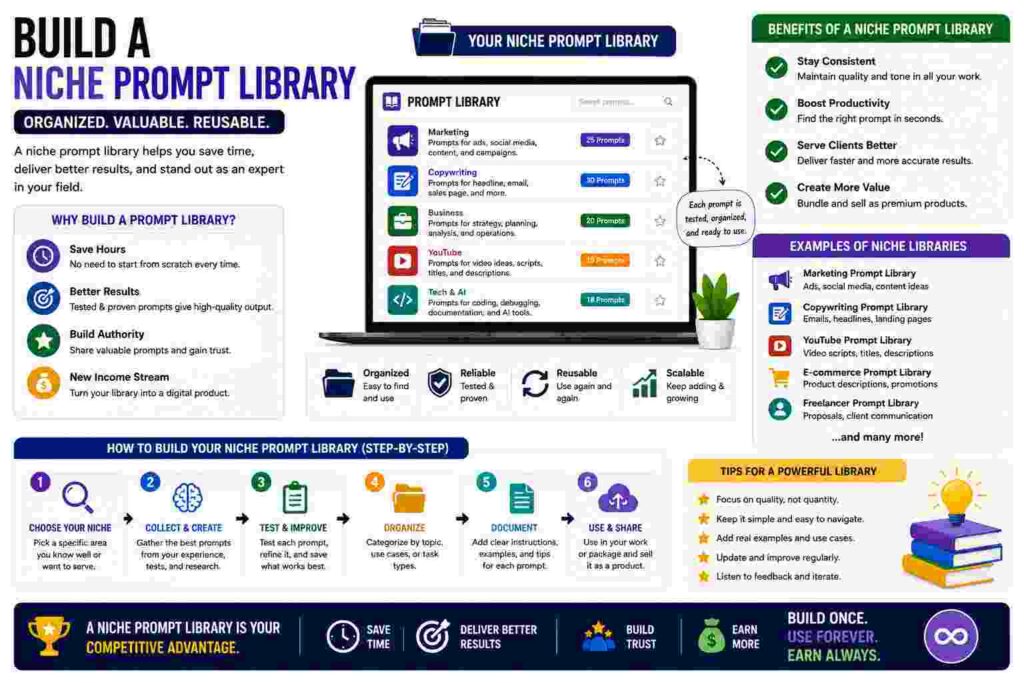
Step 5: Build a niche prompt library
Pick one industry or use case you’re most interested in — real estate, e-commerce, coaching, legal, whatever connects to your existing skills or interests. Build a library of fifty to one hundred prompts specifically for that niche. Test each one, refine the ones that underperform, and document what works.
This library becomes the foundation for a digital product, a consulting offer, or simply a competitive advantage in your own freelance work.
Step 6: Teach what you know
The fastest way to deepen any skill is to teach it. Start writing about prompting — a newsletter, a blog, LinkedIn posts, YouTube shorts demonstrating before and after outputs. Teaching forces you to articulate what you know precisely, surfaces gaps in your understanding, and builds an audience for any product or service you eventually offer.
Mistakes That Keep People at the Beginner Level
Treating every prompt as a one-shot interaction. The best results almost always come from iteration — an initial prompt, then refining based on the output, then refining again. People who expect one perfect prompt to produce one perfect output miss how the back-and-forth conversation elevates quality significantly.
Being vague about audience. One of the most common prompting mistakes is forgetting to specify who the output is for. The same information written for a beginner versus an expert should look and feel completely different. Specify your audience every time.
Ignoring negative instructions. Telling the AI what not to do is just as important as telling it what to do. If you hate bullet points, say so. If you want to avoid corporate-sounding language, be explicit about it. If certain phrases make you cringe, list them. Negative constraints dramatically sharpen output.
Not verifying factual claims. Good prompting produces better outputs but it doesn’t make AI infallible. Always verify specific facts, statistics, dates, and names that appear in AI output before using them professionally. This is non-negotiable.
Assuming prompting skill transfers automatically. Someone who prompts brilliantly for creative writing tasks needs to deliberately develop their prompting approach for data analysis, or legal summarization, or technical documentation. Each domain has its own nuances. Stay curious and keep learning across use cases.
The Honest Trajectory of This Skill
Prompting is genuinely learnable in weeks, not years. But the difference between someone who spent two weeks deliberately practicing it and someone who’s been casually using AI for a year without thinking about it is dramatic.
The casual user gets outputs they settle for.
The deliberate practitioner gets outputs they’re genuinely proud of — fast enough to make the economics of their work completely different.
That gap is where the income opportunity lives. Not in some secret knowledge most people don’t have access to. Just in the willingness to take the mechanics of communicating with AI seriously when most people treat it as an afterthought.
The window where this is a differentiating skill won’t be open forever. As AI tools get more intuitive, prompting will become less of a distinct skill and more of a baseline expectation. People who develop genuine expertise now will be ahead when that shift happens rather than scrambling to catch up.
That’s probably the most honest argument for taking this seriously right now rather than later.
Nothing in this article guarantees specific income outcomes. Results from developing any skill vary based on individual effort, application, and market conditions.