About two years ago I watched a YouTube video of a guy showing his Shopify dashboard — $47,000 in sales in a single month, all from a dropshipping store he claimed ran “almost entirely on autopilot with AI.” He had a ring light, a nice apartment background, and very confident energy.
I did what most people do. I got excited, opened a new browser tab, and started Googling how to do it myself.
What followed was three months of trial and error, two stores that flopped, one store that actually worked, and a very honest education in what AI dropshipping really is versus what people on the internet want you to think it is.
So let me save you some time and tell you the truth — the good parts, the bad parts, and the stuff nobody mentions in those YouTube thumbnails.
What Is AI Dropshipping, Really?
If you’re new to this, here’s the basic idea behind dropshipping. You run an online store but you never hold any inventory. When a customer buys from you, the order goes directly to a supplier who ships it to them. Your job is to run the store, handle marketing, and keep customers happy.
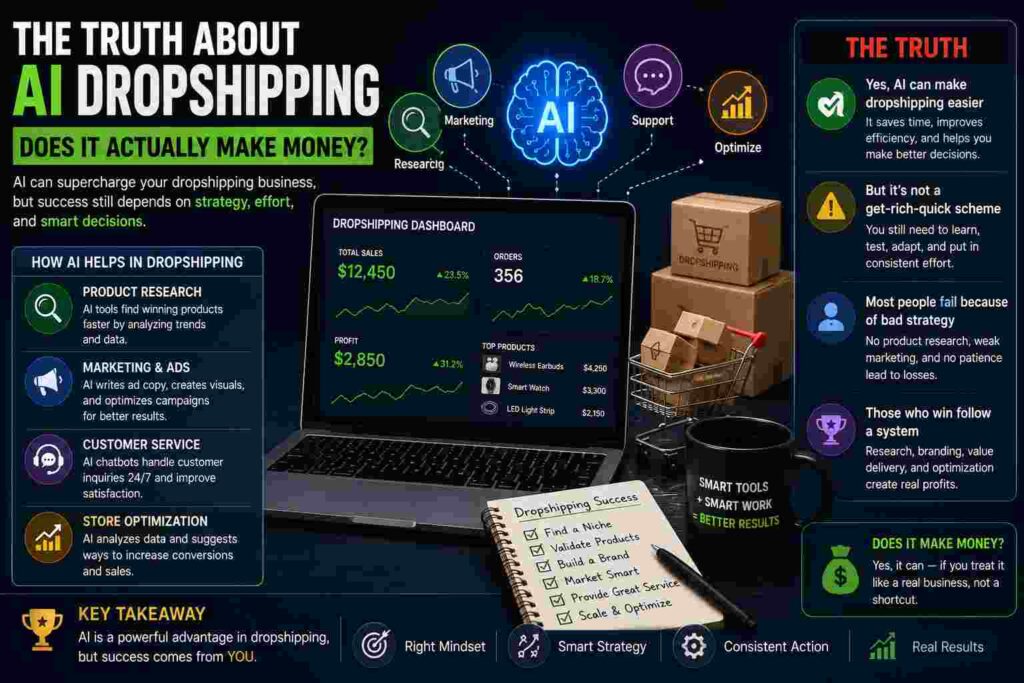
AI dropshipping just means you’re using artificial intelligence tools to handle parts of that process — writing product descriptions, generating ad copy, finding trending products, handling customer service, and so on.
The appeal is obvious. Less manual work, faster execution, potentially more stores running simultaneously.
The reality is more complicated.
The Part Nobody Tells You Upfront
Here’s what I wish someone had told me before I started.
AI doesn’t fix a bad business. It amplifies whatever you’re already doing. If your product selection is weak, AI-generated descriptions won’t save you. If your pricing is wrong, automated ads won’t help. If your supplier ships slow, no chatbot will keep customers from leaving bad reviews.
The people making real money with AI dropshipping aren’t using AI as a replacement for business sense. They’re using it as a tool to execute faster on decisions they’ve already thought through carefully.
That distinction matters more than anything else in this article.
Where AI Actually Helps in Dropshipping
Let me walk through the specific areas where I’ve seen AI make a genuine difference — and where I’ve used it myself.
Product Research
Finding winning products is the hardest part of dropshipping. Most people do it wrong by just browsing AliExpress bestseller lists and picking whatever looks popular.
AI-powered tools like Minea, Sell The Trend, and Zik Analytics analyze social media engagement, ad activity, and sales velocity across platforms to surface products that are gaining traction before they become completely saturated.
I started using Minea seriously about fourteen months ago. It tracks Facebook and TikTok ads and shows you which product ads are getting the most engagement and for how long they’ve been running. A product with an ad that’s been running profitably for six weeks is a much better signal than something that just appeared on AliExpress trending.
Did it find me winners every time? No. But my product research quality improved noticeably compared to manual scrolling.
Product Descriptions and Store Copy
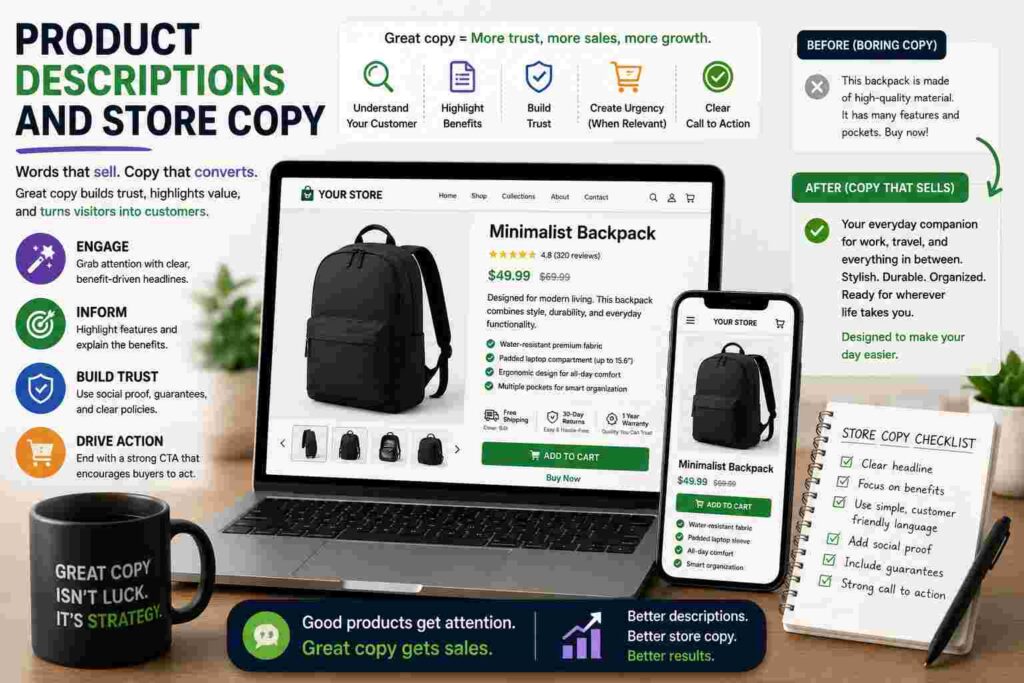
This is where AI saves the most raw time. Writing unique, compelling product descriptions for 50 products used to take days. With ChatGPT or Claude, you can generate solid first drafts in an afternoon.
But — and this is important — you cannot just copy-paste AI output directly into your store. Google can identify thin, generic content and it hurts your SEO. Customers can tell when a description reads like it was written by a robot. You need to edit, add specific details, inject personality, and make it sound like a real person who actually cares about the product.
I use AI as a starting point, not a finishing point. That nuance saved me from launching a store full of descriptions that read like assembly instructions.
Ad Copy and Creative Briefs
Writing Facebook and TikTok ad copy used to take me a long time because I’d second-guess every word. Now I use AI to generate ten variations of a hook or headline, pick the two or three that feel strongest, tweak them, and test.
Tools like AdCreative.ai are built specifically for this — they generate ad visuals and copy combinations and even predict which ones are likely to perform better based on historical data.
I won’t pretend it’s magic. But it cuts my creative testing time in half, which means I can run more experiments with the same budget.
Customer Service Automation
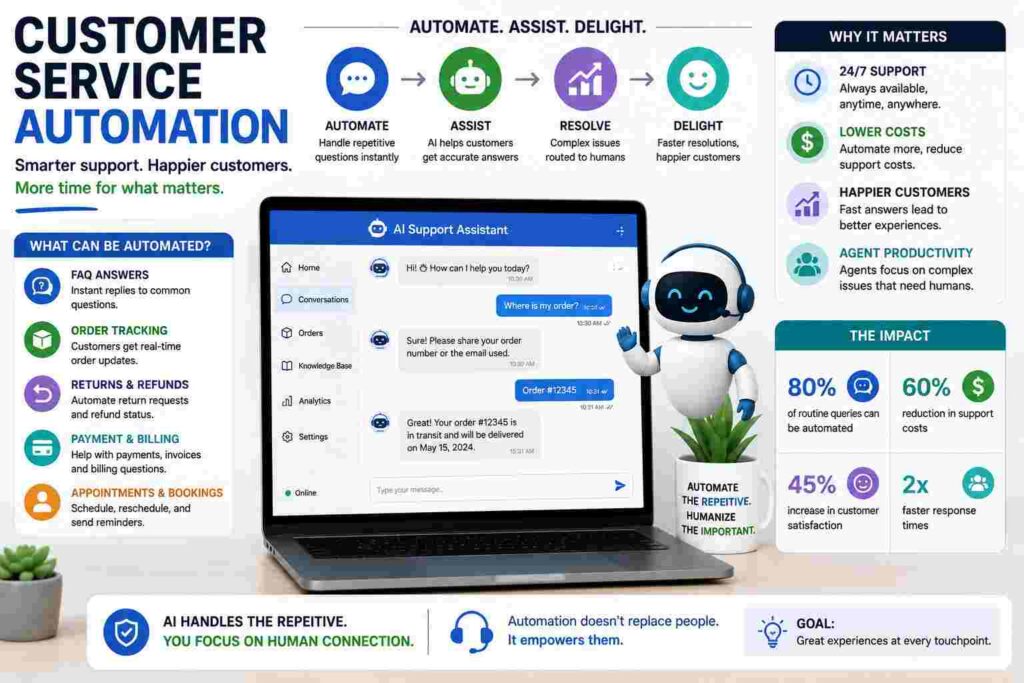
This one surprised me. I set up a simple AI chatbot using Tidio on one of my stores to handle the most common questions — where’s my order, can I return this, do you ship to this country.
It handled about 65% of incoming messages without me needing to touch them. That’s 65% of my customer service time back. For the remaining 35% that needed real human attention, the chatbot collected the relevant details so I could respond faster.
For a one-person operation, that’s genuinely significant.
The Store That Failed and Why
My first AI dropshipping store was a general pet products store. I used AI to find products, write descriptions, and generate ads. I launched and waited.
Almost nothing sold. The few sales I got resulted in complaints about shipping times — three to four weeks from Chinese suppliers.
Here’s what I did wrong. I was so focused on the AI tools and automation that I skipped the fundamentals. I didn’t research my target customer properly. I didn’t vet my suppliers for shipping speed. I picked a niche that was completely saturated. And my product pages, despite being AI-generated, were generic and unconvincing.
The AI tools worked fine. My business thinking was the problem.
The Store That Actually Worked
My third store — a niche home organization store targeting small apartment dwellers — started making consistent sales within about six weeks of launch.
What was different this time had less to do with AI and more to do with focus.
I picked a specific customer in my head — a 28-year-old renting a small apartment in a city, obsessed with making a small space feel organized and calm. Every product I chose, every description I wrote, every ad I ran was aimed at that specific person.
AI helped me execute faster. But the strategy — the customer focus, the niche clarity, the supplier vetting for faster shipping — that was all manual thinking upfront.
By month three I was pulling in around $4,000 to $6,000 in monthly revenue with profit margins around 20–25% after ad spend and supplier costs. Not life-changing, but real and growing.
Step-by-Step: How to Start AI Dropshipping Without Wasting Money
Step 1: Pick a niche with a specific customer in mind
Don’t pick “fitness” or “pets” — pick “home gym equipment for apartment dwellers” or “accessories for first-time dog owners.” The more specific you are, the easier everything else becomes. Use tools like Google Trends and Reddit to validate that real people are actively interested in this space.
Step 2: Find products with proven demand
Use Minea or Sell The Trend to find products with active ad campaigns that have been running for more than three weeks. That’s usually a signal someone is making money on it. Check the comments on those ads to understand what customers actually think about the product.
Step 3: Vet your suppliers carefully
Order samples before selling anything. Check shipping times — ideally you want suppliers offering seven to fourteen day delivery, not three to four weeks. Platforms like Zendrop and Spocket connect you with US and European-based suppliers for faster shipping, which dramatically reduces customer complaints.
Step 4: Build your store with conversion in mind
Use Shopify — it’s still the best platform for this. Keep the design clean and simple. Use AI to generate product description drafts, then rewrite them in a voice that matches your target customer. Add real photos if you can get them from your supplier samples.
Step 5: Run small ad tests before spending big
Start with $10–$20 per day on Meta or TikTok ads testing three to five different creatives. Use AI tools like AdCreative.ai to generate variations quickly. Wait until you have data before scaling. Most beginners lose money by scaling too fast before knowing what works.
Step 6: Automate customer service from day one
Set up Tidio or Freshdesk with basic AI responses to common questions before you launch. It’s much harder to set this up after you’re already getting orders and complaints.
Mistakes That Kill Most AI Dropshipping Stores
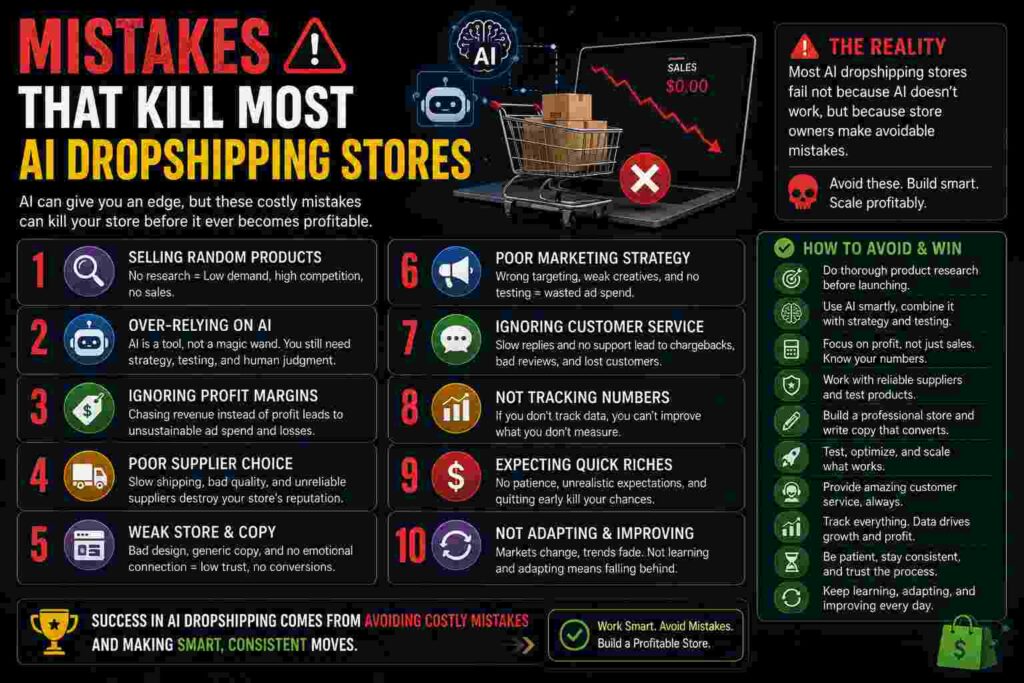
Relying on AI to make business decisions for you. AI tells you what’s trending. You have to decide if it makes sense for your store and your customer.
Ignoring shipping times. This is the number one reason dropshipping stores die. A customer waiting four weeks will leave a bad review and never come back. Solve this with better supplier relationships before you launch.
Not editing AI-generated content. Generic descriptions rank poorly on Google and convert poorly with customers. Always humanize the output.
Trying to sell everything to everyone. The more general your store, the harder it is to target ads effectively and the less customers trust you. Niche down.
Giving up after the first store fails. Almost nobody succeeds on the first try. The education you get from a failed store is worth more than any course you could buy.
So Does AI Dropshipping Actually Make Money?
Yes — but probably not in the way you’re imagining based on YouTube thumbnails.
The people genuinely earning from it are treating it as a real business, not a passive income machine. They’re using AI to work smarter and faster, but they’re still putting in serious thought and effort on the things AI can’t do — understanding customers, building supplier relationships, making strategic decisions.
The ones losing money are treating AI as a shortcut around the actual work of building a business. It isn’t one.
If you go in with realistic expectations, a specific niche, decent suppliers, and the willingness to learn from early failures — AI dropshipping can absolutely generate real income. It’s not a lottery ticket. It’s a business with better tools than existed five years ago.
That’s both more exciting and more honest than what most people are telling you.
Nothing in this article is a guarantee of income. All business results vary based on execution, market conditions, and individual effort. Always research thoroughly before investing money in any business model.