I spent the better part of last year building a personal finance blog.
Wrote thirty-something articles. Decent content, honestly. Spent real time on research. Published consistently. Did everything the standard advice said to do.
Eight months in, I was getting maybe 600 organic visitors a month. The niche was so crowded with massive authority sites that my little blog was basically invisible. NerdWallet, Investopedia, The Balance — these sites have hundreds of writers, millions of backlinks, and decade-old domain authority. I was trying to compete with a plastic spoon.
That experience taught me the single most important lesson in online business. The niche you pick matters more than how hard you work. You can outwork everyone and still lose if you’re fighting in the wrong arena.
After that blog quietly died, I changed my whole approach to niche research. I started using AI tools to find smaller, less competitive, but genuinely profitable corners of the internet before the crowds arrived. The results were completely different.
This is everything I learned about that process.
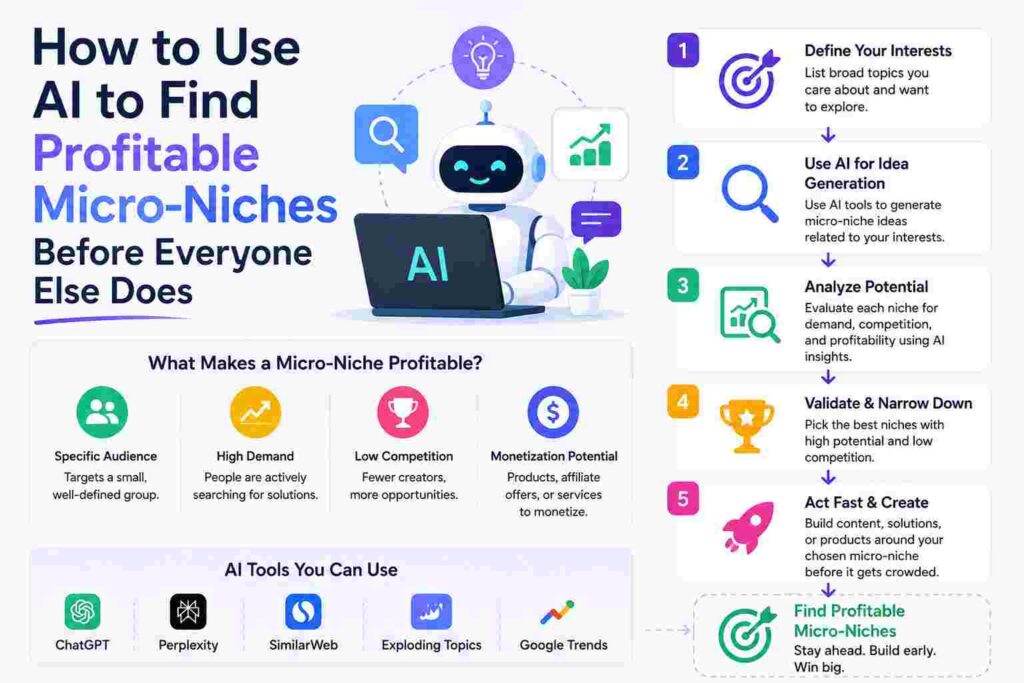
What a Micro-Niche Actually Is and Why It Beats Broad Niches
A broad niche is something like “fitness,” “personal finance,” or “travel.” Millions of searches, thousands of established competitors, almost impossible to break into without serious resources.
A micro-niche is a specific slice of that broader category. Not “fitness” — but “mobility exercises for desk workers over 40.” Not “travel” — but “slow travel in Southeast Asia for remote workers.” Not “personal finance” — but “budgeting strategies for freelance creatives with irregular income.”
The searches are lower volume. But the competition is dramatically thinner, the audience is more specific, and the people searching are often more committed buyers because they have a very particular problem they need solved.
The goal isn’t to find a niche with the most traffic. It’s to find a niche where you can actually win — and where the audience has money and motivation to spend it.
AI tools have made finding these pockets genuinely faster and more systematic than it used to be.
Why Most People Get Niche Research Wrong
The standard advice is to use a keyword tool, find something with decent search volume and low competition, and build around that.
The problem is that keyword tools show you what’s already being searched at scale. By the time a keyword shows meaningful volume, there are already established players targeting it. You’re not early — you’re late.
The better approach is to spot trends and audience pain points before they show up clearly in keyword data. That’s where AI becomes genuinely valuable — it can synthesize signals from across the internet that a basic keyword tool completely misses.
The AI Tools That Actually Help With Micro-Niche Research
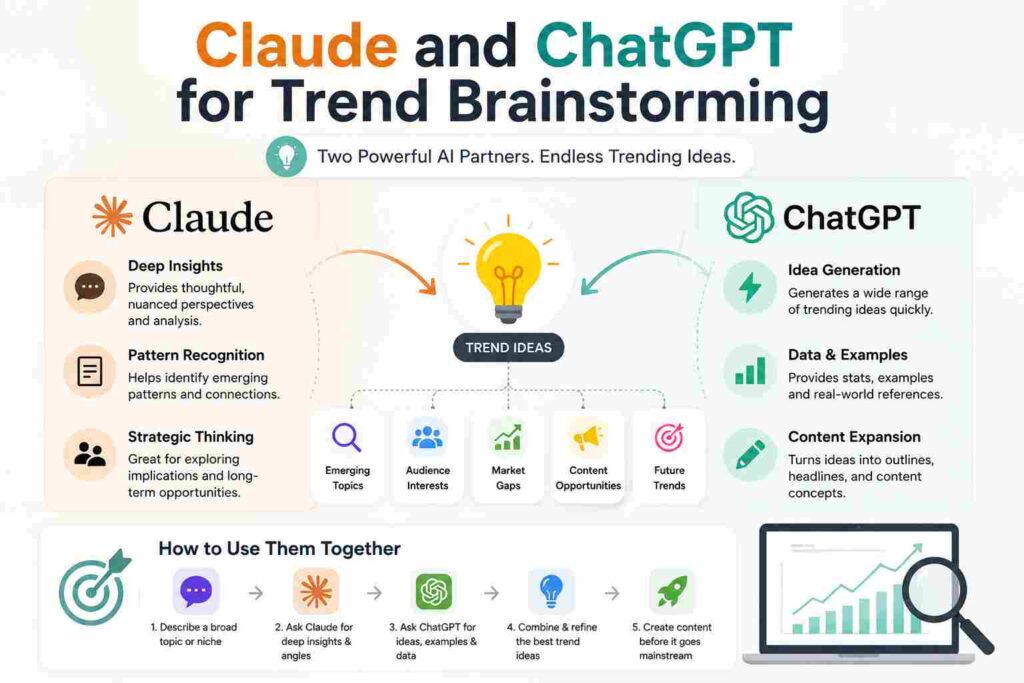
Claude and ChatGPT for Trend Brainstorming
This is where I start every niche research session now. Not with a keyword tool — with a conversation.
I’ll open Claude and give it a broad category I’m interested in, then ask it to identify underserved subgroups within that category. Specific prompts I’ve used that generated genuinely useful ideas:
“What are the most common frustrations people have within the broad fitness niche that mainstream fitness content completely ignores?”
“What types of travelers are growing in numbers but have almost no dedicated content or communities serving them?”
“What emerging work styles or career situations create financial challenges that standard personal finance advice doesn’t address?”
The answers aren’t always immediately usable. But they consistently point me toward angles I wouldn’t have thought of on my own. It’s like having a brainstorming session with someone who has read everything on the internet and can synthesize it quickly.
Google Trends for Early Signal Detection
Google Trends is criminally underused for niche research. Most people check it once to see if a topic is growing or declining and move on.
But the real value is in the “Related Queries” section at the bottom — specifically the ones marked as “Breakout.” These are searches that have recently exploded in volume, sometimes by hundreds of percent. That’s where you find genuine early signals.
I cross-reference AI-generated niche ideas against Google Trends to see if there’s a rising pattern. If Claude surfaces an interesting angle and Google Trends shows it breaking out in the last six to twelve months, that’s a strong signal worth investigating further.
Reddit and Quora for Real Human Pain Points
No AI tool replaces the raw signal you get from reading actual human conversations about problems.
I use a specific process. Once I have a shortlist of potential micro-niches from my AI brainstorming, I go to Reddit and search for subreddits in that space. Then I sort posts by “Top” over the last year and read what people are actually frustrated about, confused by, or desperate to find answers to.
The questions that have hundreds of upvotes and dozens of comments but no single satisfying answer — those are your content opportunities. Those are the posts that tell you what the internet still genuinely needs.
I then feed those Reddit threads back into Claude and ask it to identify the five most common unresolved pain points from the conversation. It synthesizes the themes quickly and surfaces patterns I might miss reading manually.
Exploding Topics for Pre-Trend Identification
Exploding Topics is a tool built specifically to surface trends before they hit mainstream. It tracks search growth, social signals, and startup activity to identify topics gaining momentum.
I check it every couple of weeks just to stay aware of what’s emerging. It’s not always directly applicable to niche research but it consistently gives me ideas that I then explore further with AI brainstorming.
The free version is useful. The pro version gives you earlier signals and more data but the free tier is enough to start.
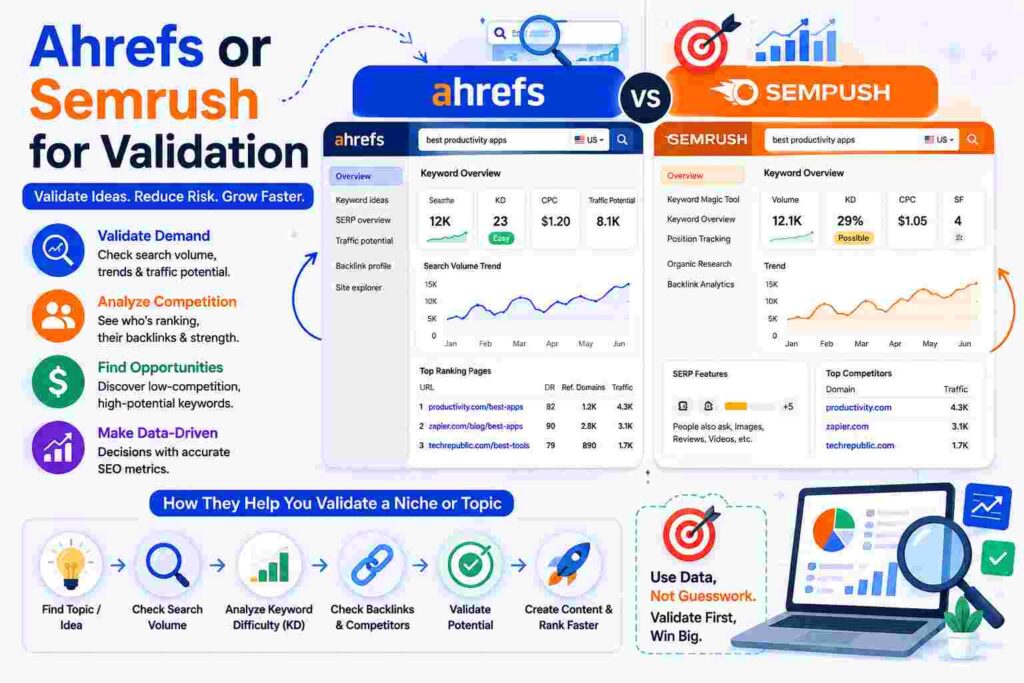
Ahrefs or Semrush for Validation
Once I have a shortlist of potential micro-niches that seem promising based on the above research, I validate them with a proper keyword tool.
I’m not looking for high volume here. I’m looking for a cluster of keywords with low keyword difficulty scores — under 20 ideally — that together represent a meaningful audience. Fifteen keywords each with 500 to 2,000 monthly searches and difficulty scores under 20 is a far better situation than one keyword with 50,000 searches and difficulty of 75.
My Actual Step-by-Step Process for Finding Micro-Niches
Let me walk you through exactly how I’d approach this starting from scratch today.
Step 1: Pick a broad parent category you have some genuine interest or knowledge in
This matters more than people admit. You’ll be creating content in this space for months or years. Complete indifference to the topic makes that miserable and the content will show it. Doesn’t need to be your passion — just something you’re reasonably curious about.
Step 2: Run a brainstorming session with Claude or ChatGPT
Give it the parent category and ask for underserved subgroups, emerging audiences within that category, and pain points that mainstream content ignores. Ask follow-up questions. Push it to go deeper. The first answers are usually surface level — the interesting stuff comes two or three prompts in.
Step 3: Take your most interesting ideas to Reddit
For each promising angle, find the relevant subreddits and spend an hour reading top posts from the last year. You’re looking for recurring frustrations that don’t have great answers. Note the exact language people use to describe their problems — this becomes your content language later.
Step 4: Check Google Trends for each shortlisted niche
Look at the five-year trend line. Is it growing, flat, or declining? Check the related breakout queries. A niche with a clearly upward trajectory is much more attractive than one that’s plateauing.
Step 5: Feed your Reddit findings back into AI for synthesis
Copy paste the most upvoted posts and comments from your Reddit research into Claude and ask it to identify the most common unresolved questions and pain points. This saves hours of manual analysis and often surfaces patterns you’d miss.
Step 6: Validate with keyword research
Take your refined niche idea into Ahrefs or Semrush. Search for the core topic and look at the keyword suggestions. Build a list of twenty to thirty keywords that are relevant, have some search volume, and have low difficulty scores. If you can find that, you have a viable niche.
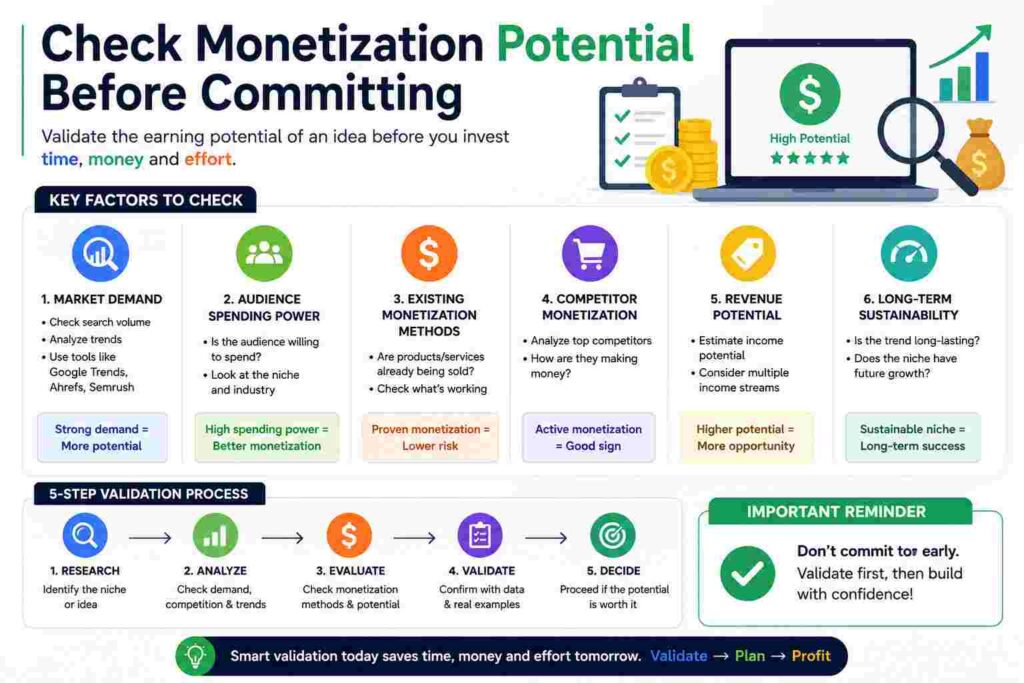
Step 7: Check monetization potential before committing
This step saves a lot of heartbreak. Before building anything, verify that people in this niche actually spend money. Look for affiliate programs in the space, check if there are products on Amazon related to the niche, see if there are advertisers running Google ads on relevant search terms. No monetization path means no revenue no matter how much traffic you get.
Real Examples of Micro-Niches I’ve Identified Using This Process
I don’t want to hand you my actual current projects because I’m still building in some of these spaces. But here are the types of angles this process surfaces — real categories with genuine potential that I’ve come across through AI-assisted research.
Perimenopause fitness — Women in their late 30s and 40s dealing with hormonal changes that make standard fitness advice completely ineffective for them. Huge and growing audience, deeply underserved by mainstream fitness content, strong product and supplement affiliate potential.
Van life for older adults — The van life movement skews young in its content but a growing segment of people in their 50s and 60s are embracing it, especially post-retirement. Their concerns — safety, medical access, comfort, finances — are completely different from what 25-year-old van life creators cover.
Solopreneur mental health — The psychological challenges of running a business completely alone. Isolation, decision fatigue, anxiety, the lack of colleagues to reality-check ideas with. Mainstream entrepreneurship content ignores this almost entirely.
Sustainable fashion on a tight budget — Ethical fashion content typically targets higher-income audiences. There’s almost no content serving people who genuinely want to be more sustainable but are working with serious budget constraints.
None of these are niches I invented. They’re gaps I found by combining AI brainstorming with real human research from Reddit and Quora. The internet is full of these gaps if you know how to look.
Mistakes That Lead People to the Wrong Niches
Choosing a niche based on passion alone without checking competition. You can love a topic deeply and still build in an impossible market. Passion helps you stay consistent but it doesn’t make a crowded niche less crowded.
Stopping at keyword volume. Low search volume doesn’t automatically mean bad niche. A highly specific niche with modest search volume but a committed, spending audience can be far more profitable than a broad niche with massive traffic potential.
Not checking if the audience actually spends money. Some communities are passionate and large but notoriously resistant to spending. Know this before you build.
Picking a niche that’s too narrow. There’s a difference between a focused micro-niche and one so small there’s nothing to build. You need enough related topics to sustain ongoing content — ideally at least fifty reasonable article ideas before you commit.
Trusting AI outputs without verifying them. AI brainstorming surfaces ideas — it doesn’t validate them. Always take AI-generated niche ideas through the Reddit and keyword validation steps before committing.
The Actual Advantage of Moving Early
Here’s the thing about micro-niche research that doesn’t get said enough.
Being six to twelve months early in a niche is worth more than being technically excellent in a crowded one. The first site to build genuine topical authority in an emerging niche captures a positioning advantage that lasts for years. Google rewards established authority. Audiences trust the sites they found first.
The people building in “van life for older adults” or “perimenopause fitness” right now — before there are twenty authority sites in those spaces — are going to have a fundamentally different experience than the people who arrive two years from now when it’s established and competitive.
AI tools have made it genuinely possible for individual creators to spot these windows early. That’s the real opportunity here — not just finding a less competitive niche but finding one where you can be among the first serious voices.
That timing advantage, combined with consistent effort and genuine usefulness to your audience, is how smaller blogs and content businesses beat much larger competitors.
The window doesn’t stay open forever. But right now there are more of these gaps than there have ever been — because the internet is growing into new audience segments faster than content creators are filling them.
That’s where you want to be.
Always validate any niche thoroughly before investing significant time or money. Market conditions change and past trend data does not guarantee future search growth.