I’ll be honest with you. Three years ago I was the guy refreshing CNBC every morning, scribbling notes from YouTube finance channels, and making investment decisions based on gut feeling mixed with whatever the loudest voices on Reddit were saying that week.
I lost a decent chunk of money during a volatile stretch in 2022. Not life-ruining money, but enough to make me sit down and seriously rethink how I was approaching this whole thing.
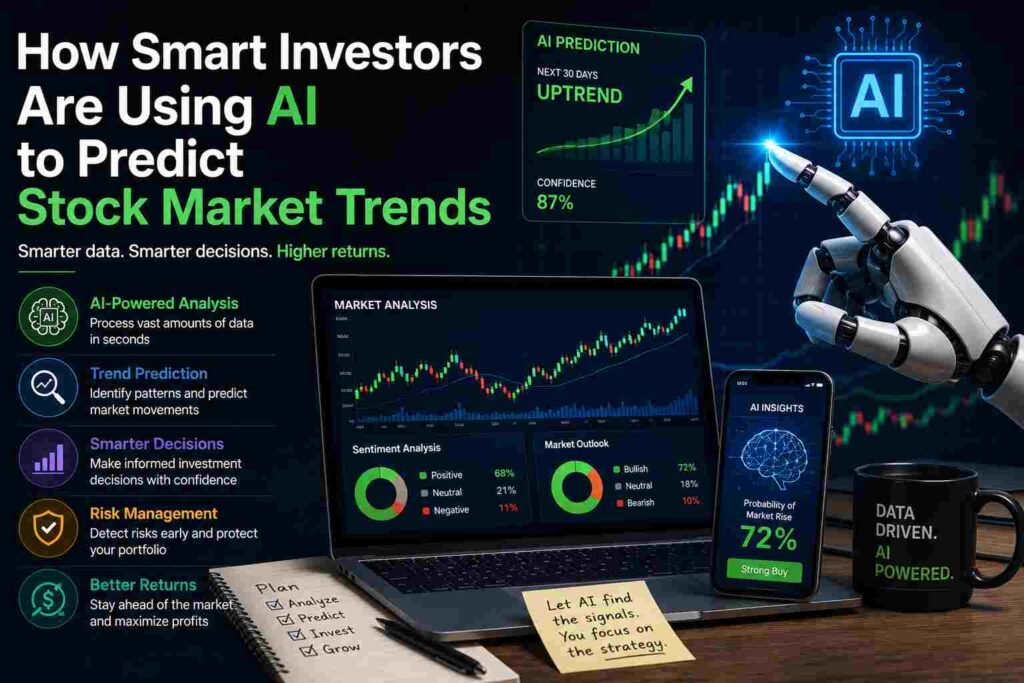
That’s when I started paying attention to how some investors — not hedge fund billionaires, just regular sharp people — were using AI tools to make more informed decisions. Not to predict the future perfectly. That’s not what this is about. But to cut through the noise, spot patterns faster, and stop making emotionally-driven trades they’d regret a week later.
This article is what I learned from going down that rabbit hole — and actually using some of these tools myself.
First, Let’s Kill the Fantasy
Before anything else, let me be straight with you.
No AI tool can tell you with certainty that a stock will go up tomorrow. Anyone selling you that idea is lying. Markets are influenced by too many unpredictable things — geopolitical events, a CEO saying something weird in an interview, a single tweet from the wrong person.
What AI can do is process enormous amounts of data faster than any human, identify historical patterns, flag anomalies, and help you make more rational decisions. It removes some of the emotional noise that causes most retail investors to buy high and panic-sell low.
That’s the realistic value. And honestly, that alone is worth a lot.
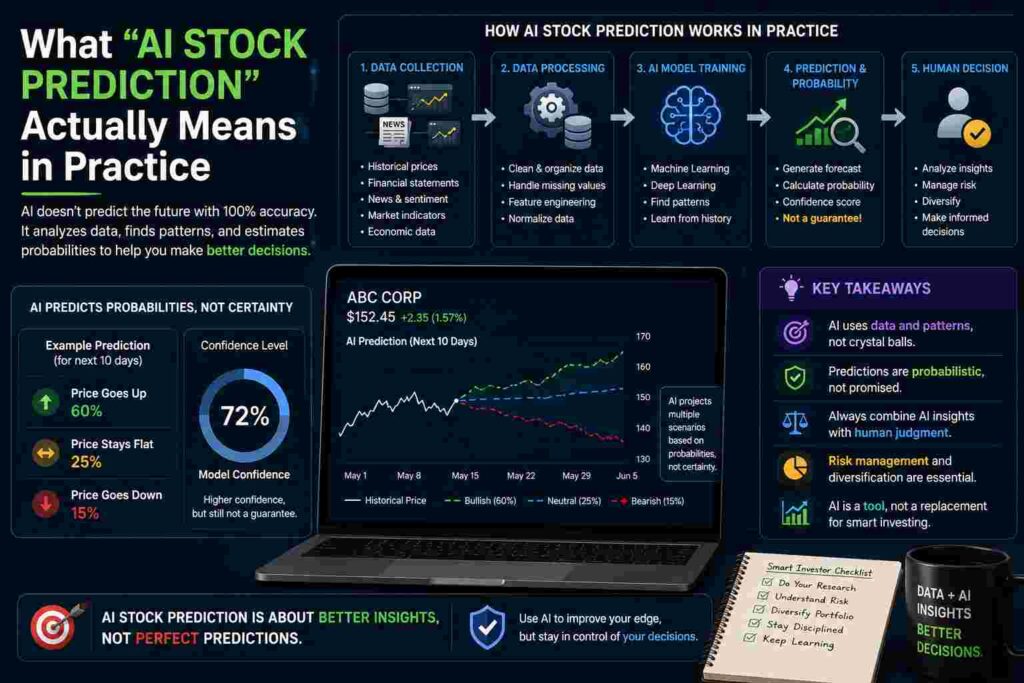
What “AI Stock Prediction” Actually Means in Practice
When people hear “AI predicting stocks,” they imagine some sci-fi machine spitting out tomorrow’s prices. The reality is more boring — and more useful.
AI in investing mostly works through a few different approaches.
Sentiment analysis is one of the big ones. These tools scan thousands of news articles, earnings call transcripts, social media posts, and analyst reports to gauge whether the general mood around a stock or sector is shifting positive or negative. The idea is that sentiment often moves before price does.
Pattern recognition is another. AI models trained on decades of price and volume data can flag when a current chart pattern resembles setups that historically preceded big moves — up or down.
Macro signal processing involves tracking economic indicators, interest rate movements, currency shifts, and correlating them with sector performance. Doing this manually would take a research team weeks. AI does it in seconds.
None of these guarantee anything. But together, they give you a better-informed starting point than a Reddit thread.
Tools Real Investors Are Actually Using
I’ve personally tested or researched all of these. Some I use regularly, some I tried and moved on from.
Trade Ideas
This is probably the most well-known AI-powered stock scanner for active traders. It has a feature called Holly — an AI system that runs overnight simulations and surfaces trade setups for the next day based on historical pattern matching.
It’s not cheap. But serious day traders swear by it. I used the free trial and found Holly’s picks genuinely interesting — not as a buy-this-now signal, but as a starting point for my own research.
Kavout
Kavout uses machine learning to generate what they call a “Kai Score” for individual stocks — basically a rating from 1–9 that reflects predicted short-term performance based on pattern analysis and quantitative factors.
I tested this for about two months. The scores were useful for filtering watchlists, though I learned quickly not to treat any single score as gospel. It works better as one signal among several.
Danelfin
This one I found more recently. Danelfin uses AI to analyze over 900 daily features per stock — technical, fundamental, and sentiment-based — and outputs a simple score. What I like about it is the explainability. It doesn’t just give you a number, it tells you why a stock is scoring the way it is.
For newer investors especially, that transparency is genuinely educational.
ChatGPT and Claude for Research
This might surprise you, but I use AI assistants as research accelerators more than anything else.
Before diving into a sector or a specific company, I’ll ask Claude to summarize recent developments, identify key risks, and explain the competitive landscape in plain language. It’s not giving me stock tips — it’s helping me understand context faster so I can make better decisions.
The key is asking good questions and verifying what it tells you through primary sources. Use it as a research starting point, not an endpoint.

Unusual Whales and Market Chameleon
These aren’t pure AI tools, but they use algorithmic analysis to track unusual options activity — large bets being placed by institutional players that sometimes signal where big money thinks a stock is heading.
Smart investors watch these flows carefully. It doesn’t tell you what will happen, but knowing that someone just bought $2 million in call options on a mid-cap biotech three weeks before an FDA decision is worth knowing.
How I Actually Use These Tools Together
Here’s my rough workflow when I’m researching a potential investment.
Start with the macro picture. I’ll use an AI assistant to get a quick summary of what’s happening in the sector — recent news, analyst sentiment, any regulatory changes on the horizon.
Check sentiment scores. I’ll look at what Danelfin or Kavout is saying about the stock. Not to make a decision, but to see if the AI is flagging anything I might be missing.
Look at unusual activity. If there’s notable options flow on the stock, I want to know about it. Unusual Whales is my go-to for this.
Do my own fundamental check. Revenue growth, profit margins, debt levels, competitive position. No AI replaces this step. I do it myself.
Then I decide. After all of that, the actual decision is still mine. The AI tools just mean I’m walking into that decision with more information and less noise.
Step-by-Step: Getting Started Without Overwhelming Yourself
If you’re new to this, don’t try to use five tools at once. Start simple.
Step 1: Pick one AI research tool and learn it properly. I’d suggest starting with Danelfin because it’s accessible and explains its reasoning. Spend two to four weeks just reading its analysis without making any trades based on it.
Step 2: Use an AI assistant for sector research. Before investing in any company, ask Claude or ChatGPT to walk you through the industry landscape, key risks, and recent news. Compare what it tells you to what you find from primary sources like SEC filings or earnings transcripts.
Step 3: Add sentiment tracking. Start following news sentiment around your watchlist stocks. You can do this through tools like Finviz (which aggregates news) or through platforms with built-in sentiment scores.
Step 4: Track your decisions and reasoning. This is the step most people skip and the one that matters most. Every time you make a trade, write down why — including what signals or tools influenced you. After three months, review your notes. You’ll see patterns in your own decision-making that are more valuable than any AI score.
Step 5: Adjust and refine. You’ll find some tools speak to your investing style more than others. Double down on what’s working and cut what isn’t.

Mistakes I’ve Seen People Make (Including Myself)
Treating AI signals as buy/sell commands. The moment you stop thinking and just follow the score, you’ve given up the most important part of the process — your own judgment. AI is an input, not a decision-maker.
Ignoring the fundamentals. No sentiment score makes up for a company burning cash with no clear path to profitability. Use AI to filter and surface ideas, but always check the underlying business.
Overtrading because the tools make it feel easy. Having good tools can make you overconfident. You start seeing signals everywhere and making more trades than you should. More trades usually means more fees and more mistakes.
Not accounting for black swan events. AI models are trained on historical data. They have no idea that a pandemic is coming, or that a major bank is about to collapse over a weekend. Always size your positions with that in mind.
Paying for expensive tools before you’re ready. Some of these platforms cost $100–$300 per month. Don’t subscribe until you’ve tested the free tier and understand how you’d actually use the tool in your workflow.
What Separates Investors Who Benefit From AI and Those Who Don’t
The investors I’ve seen genuinely benefit from these tools share a few things in common.
They’re already decent investors without the AI. They have a process, they understand risk, and they’re not looking for a magic shortcut. The AI just makes their existing process sharper.
They stay skeptical. They treat every signal as a hypothesis to investigate, not a fact to act on.
And they’re patient. AI tools help you spot opportunities — but those opportunities still take time to play out. If you’re expecting instant results, you’ll misuse the tools and blame them when things go sideways.
One Honest Observation
The edge that AI gives you in the stock market is real, but it’s probably smaller than you’re hoping for. Markets are filled with extremely smart, well-resourced people using sophisticated tools. Retail investors using AI are closing the information gap, but not eliminating it.
The bigger edge, honestly, is behavioral. AI helps you be more systematic and less emotional. And emotions are responsible for more retail investing losses than bad stock picks ever were.
If AI tools just help you not panic-sell during a correction, they’ve already paid for themselves.
Wrapping Up Naturally
Look, I’m not a financial advisor and this isn’t financial advice. I’m just someone who got tired of making uninformed decisions and started looking for better tools.
What I found is that AI doesn’t make investing easy — it makes it smarter, if you use it right. The investors winning with these tools aren’t the ones blindly following AI signals. They’re the ones using AI to ask better questions, cut through noise faster, and keep their own emotions from sabotaging them.
Start small. Stay curious. And always — always — do your own thinking at the end of it.
Investing always carries risk. Nothing in this article is financial advice. Always do your own research and consider speaking with a qualified financial advisor before making investment decisions.