I had the idea sitting in a Google Doc for three months before I did anything with it.
I’d write a sentence or two — “could automate appointment reminders for clinics,” “local gyms probably need help with their social media” — then close the laptop and go watch TV. The idea felt good in theory but genuinely scary to actually attempt. What if nobody wanted this? What if I built something nobody would pay for?
What finally pushed me was getting passed over for a promotion at my job that I’d clearly earned, watching someone with less experience and more office politics savvy get it instead. That stung enough to make the fear of failing at something new feel smaller than the fear of staying exactly where I was.
I sent my first cold email that same week. It was clumsy, too long, and probably read a little desperate. But it led to a fifteen-minute call, which led to a $250 first project, which led — eleven months later — to me leaving that job entirely.
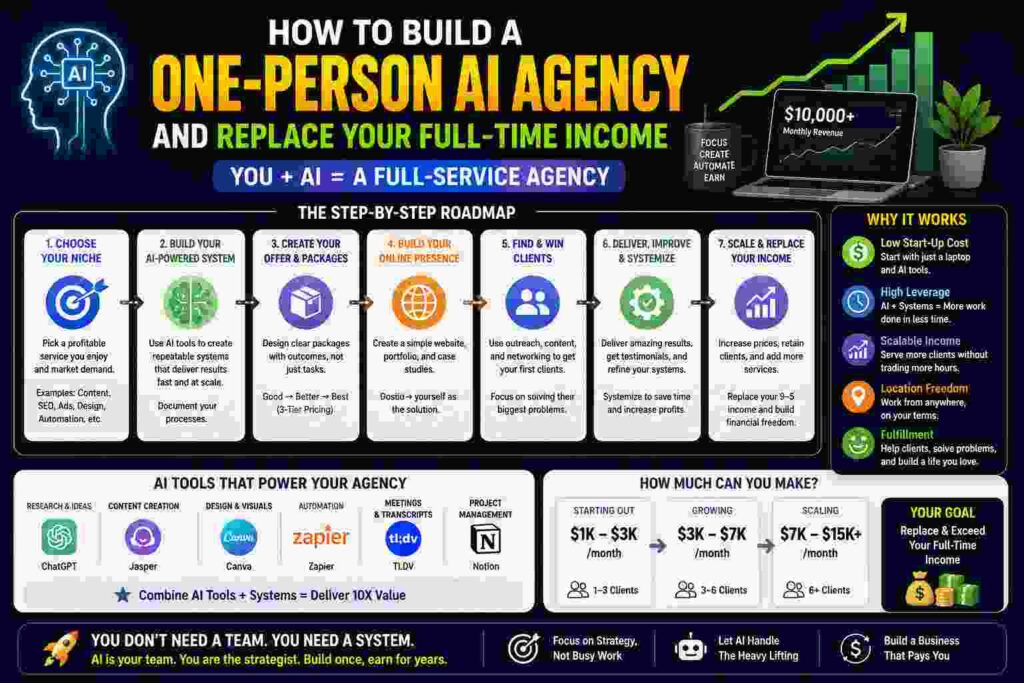
This is the version of that story focused specifically on the part most guides skip: how you actually get from zero to your first handful of paying clients when you have no portfolio, no agency name people recognize, and no idea if any of this will work.
The Part Everyone Skips: Getting Past Zero
Most advice about AI agencies jumps straight to “offer chatbot services” or “automate email responses” without addressing the actual hardest part — going from someone with an idea to someone with a paying client.
That gap is where almost everyone quits. Not because the skills are too hard. Because the uncertainty of reaching out to strangers, the fear of an awkward no, and the lack of any proof you can deliver feels paralyzing.
Here’s what actually got me through it.
Step One: Build Something Before You Sell Anything
I didn’t pitch a single client until I had a working demo to show them.
I picked a fictional dental practice and built a complete chatbot for it using Tidio — answering common questions about hours, insurance, appointment booking, and emergency contact information. Took me about a week of evenings to get it polished.
This demo became the centerpiece of every conversation I had afterward. Instead of explaining what a chatbot could theoretically do for someone’s business, I’d show them this working example and say “this is roughly what I’d build for you, customized to your specific business.”
People respond to seeing something real far more than hearing about a concept. If you’re starting from zero, build your demo before you do anything else.
Step Two: The Cold Outreach That Actually Worked
My first email was long and explained too much. It got zero responses across the fifteen businesses I sent it to.
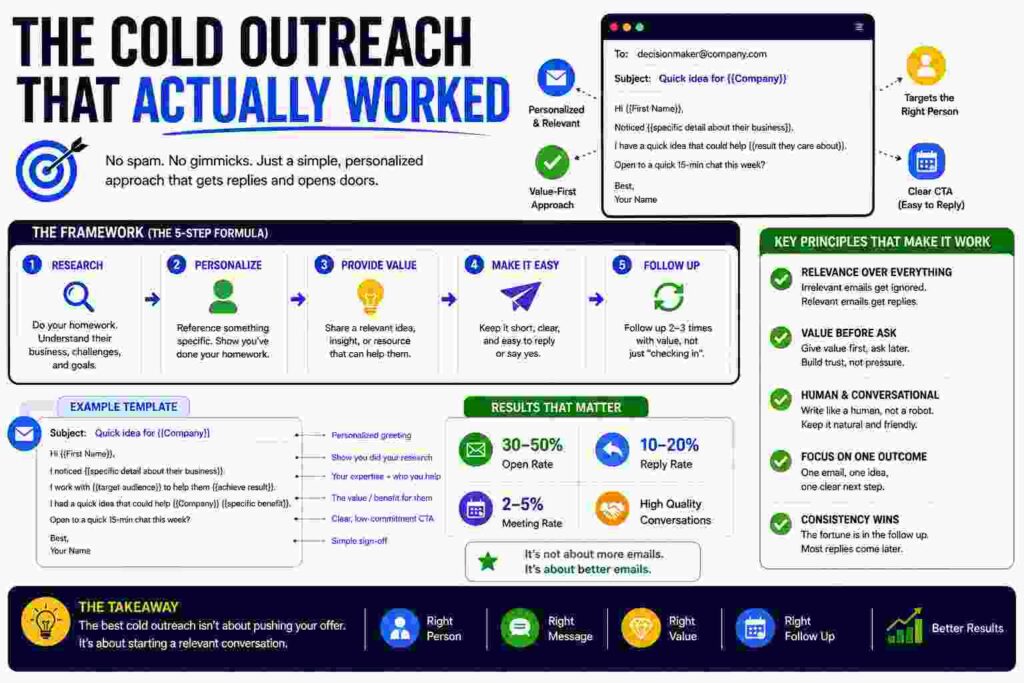
I rewrote it shorter, more specific, and focused entirely on them rather than me. This version got three responses out of twenty emails, which led to my first client.
The pattern that worked: open with something specific about their business that shows you actually looked at it, state the specific problem you noticed, offer a concrete example of what you could build, and ask for a short call rather than trying to close anything in the email itself.
I’d write something like noticing their website had no way to capture leads outside business hours, mention I build simple AI chatbot systems for businesses exactly like theirs, attach a link to my demo, and ask if they had ten minutes that week for a quick call.
Short, specific, low pressure. That combination got responses where my original generic pitch got silence.
Step Three: The First Call
I was terrified of these calls initially. What helped was reframing them — I wasn’t trying to sell anything on the call. I was trying to understand their actual problem well enough to know if I could genuinely help.
I’d ask questions about their current process, what was frustrating about it, how much time it was costing them. Most business owners love talking about their problems once you show genuine interest in understanding them.
By the end of a good call, the pitch for what I’d build practically wrote itself based on what they’d told me. I wasn’t pushing a generic service — I was proposing a specific solution to the specific thing they’d just spent ten minutes complaining about.
Step Four: Pricing Your First Few Projects
I charged $250 for that first chatbot project. Looking back it was underpriced for the value delivered, but it served its purpose — it got me a paying client, a real case study, and the confidence that someone would actually pay for this.
By my fifth project I was charging $600 to $800 for similar scope work. By month eight I was charging $1,200 to $1,800 for chatbot and automation combination projects.
The pricing growth wasn’t arbitrary. Each project added a specific result I could point to — hours saved, leads captured, response time improved — and each result became leverage for charging more on the next pitch.
Don’t be afraid to underprice your very first project if it gets you in the door. Just don’t stay there. Use each completed project as proof to justify the next price increase.
Real Services Worth Offering as You Grow
Once you’ve got your first few clients and some confidence, here’s where the real opportunity expands.
AI-powered appointment and booking systems for service businesses — dentists, salons, contractors, consultants. Combining a chatbot with a scheduling tool like Calendly creates a system that captures leads and books appointments even when the business is closed. This consistently sells well because the value is immediately obvious to any owner who’s lost a customer because nobody answered the phone.
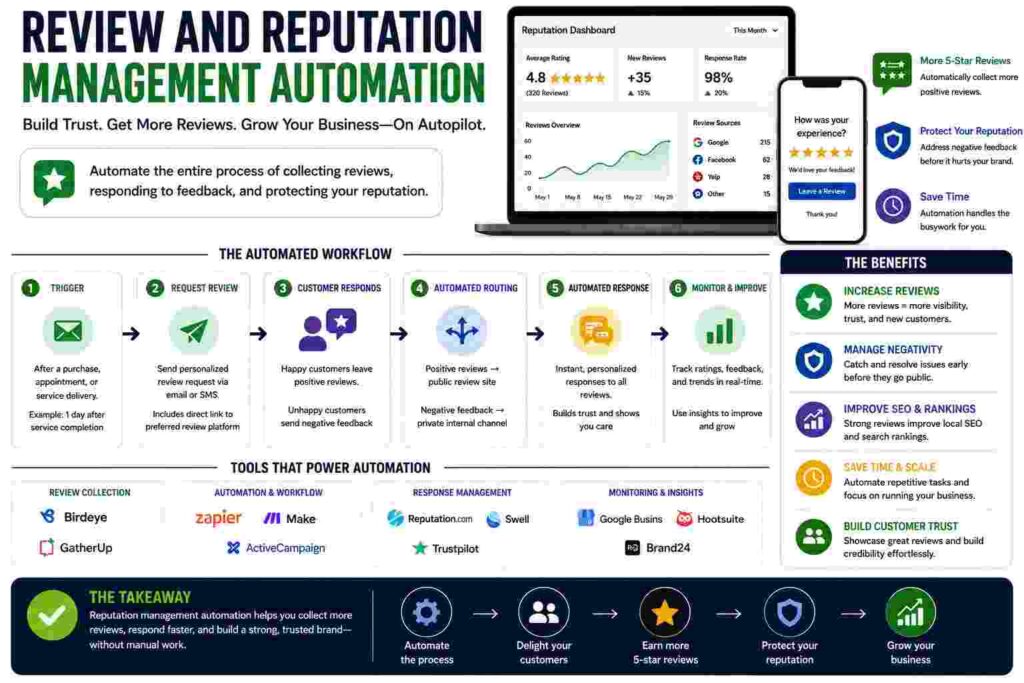
Review and reputation management automation using AI to draft personalized responses to customer reviews and follow-up requests for happy customers to leave reviews. Local businesses live and die by their online reputation and most owners are too busy to manage this consistently.
Lead qualification chatbots for businesses with higher-ticket services — real estate agents, financial advisors, B2B consultants. These chatbots ask a series of questions to filter serious prospects from casual browsers before they ever reach the business owner, saving enormous amounts of time on unqualified leads.
AI-assisted proposal and quote generation for contractors and service businesses that spend hours writing custom quotes. Building a system that pulls from templates and uses AI to customize based on client needs can cut quote turnaround from days to minutes.
What I’d Do Differently Starting Over
I’d build my demo library faster. Having three to four different demos covering different problem types from month one would have let me pitch a wider range of businesses immediately instead of slowly building variety over the first six months.
I’d ask for referrals immediately, not eventually. I waited until I had ten clients before consistently asking happy clients for referrals. That was probably five or six referrals I left on the table by not asking from project one.
I’d track my outreach numbers from day one. I didn’t track my email response rates carefully at first, which meant I couldn’t tell what was actually working versus what felt like it was working. Once I started tracking — emails sent, response rate, call booked rate, close rate — I could actually optimize my approach instead of guessing.
I’d join local business networking groups sooner. I avoided these initially because they felt intimidating and old-school compared to online outreach. They turned out to be one of my best client sources once I actually started attending, because local business owners trust referrals from people they’ve met in person far more than cold emails.
The Honest Timeline
Month one — building the demo, sending first cold emails, mostly silence and rejection.
Months two and three — first paying client, first real case study, learning how to actually run a project from start to finish without it being chaotic.
Months four through six — slow but steady growth through referrals and improved outreach, averaging two to three new clients monthly at increasing price points.
Months seven through nine — first recurring retainer clients, income becoming more predictable rather than purely project-based.
Months ten and eleven — income consistently exceeding my full-time salary, made the decision to leave my job.
This wasn’t a smooth, predictable climb. There were weeks with zero responses to outreach, projects that took twice as long as quoted, and at least one client who never paid the final invoice despite a signed agreement. The trajectory was real but the path wasn’t clean.
Mistakes That Cost Me Real Time
Spending too long perfecting my demo instead of starting outreach. I could have started reaching out two weeks earlier than I did if I’d accepted my demo was good enough rather than endlessly tweaking it.
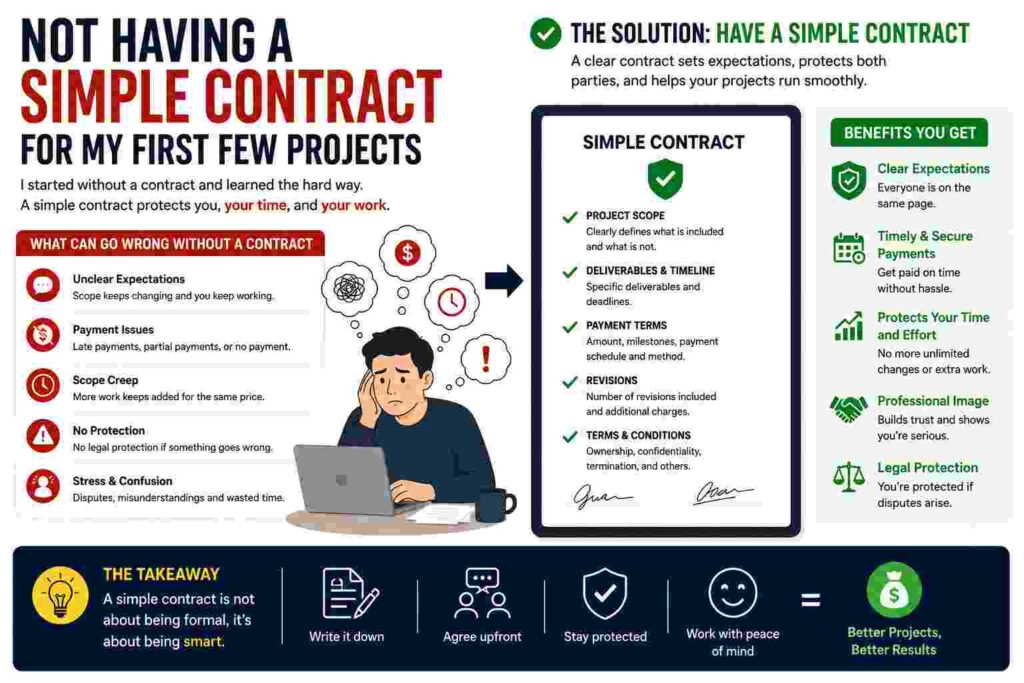
Not having a simple contract for my first few projects. I learned this lesson the hard way with an unpaid invoice. A basic agreement outlining scope, payment terms, and timeline — even a simple one-page document — should be standard from your very first paying client.
Trying to handle too many different business types at once. Jumping between dental practices, gyms, and consultants meant I never developed deep expertise in any single industry’s specific problems. Narrowing focus later made my pitches sharper and my delivery faster.
Undervaluing the discovery call. Early on I’d rush through these calls trying to get to the pitch. Slowing down and genuinely understanding the client’s problem led to better proposals and significantly higher close rates.
Final Thoughts
The technical side of building these AI solutions is genuinely the easier part. Chatbot platforms, automation tools, content systems — these have gotten accessible enough that anyone willing to spend a few weeks learning can become competent.
The harder skill, the one that actually determines whether this works for you, is having uncomfortable conversations with strangers, handling rejection without quitting, and getting genuinely curious about other people’s business problems instead of just trying to sell them something.
If you can build that muscle alongside the technical skills, this path is absolutely available to you right now — no agency experience required, no formal credentials, no existing audience. Just a willingness to start before you feel ready and keep going after the inevitable early silence and rejection.
That first email I almost didn’t send sat in my drafts for three days before I finally hit send. I think about that a lot now.
Income results vary significantly based on effort, market, location, and individual circumstances. This reflects one person’s experience and is not a guarantee of similar outcomes. Building any service business takes sustained effort over time.