I remember the exact moment the fear hit me properly.
I was on a freelance writing forum I’d been part of for a few years when someone posted a screenshot of a client message. The client had cancelled their monthly content retainer — work that had been paying this freelancer around $1,800 a month for over two years — with a single paragraph explaining they were “moving to an AI-based content solution going forward.”
The comments underneath were a mix of panic and denial. Some people insisted AI content was garbage and clients would come crawling back in a few months. Others were quietly terrified. A few had already seen similar cancellations from their own clients.
I sat with that post open for a long time.
I’d been freelance writing for three years at that point. It was my primary income. The idea that the whole thing could quietly collapse underneath me while I wasn’t paying attention was genuinely frightening.
So I did what I do when something scares me. I stopped catastrophizing and started actually investigating. I spent the next six months watching what was happening across different freelancing categories, talking to other freelancers, paying attention to where work was disappearing and where it was growing, and testing AI tools myself to understand what they could and couldn’t actually do.
What I found was more nuanced and more honest than either the panic or the denial I saw in that forum thread.
The Part That Is Actually True
Let me start with the uncomfortable part because you deserve a straight answer.
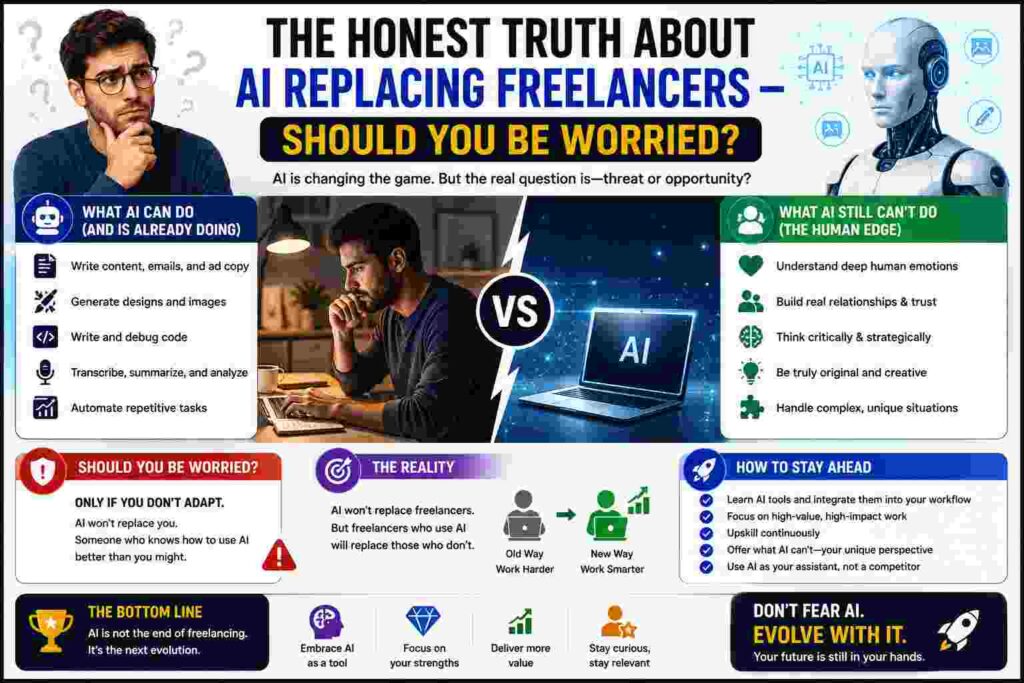
Yes, AI has already replaced certain types of freelance work. Not all of it. Not most of it. But some categories have genuinely contracted because of AI and pretending otherwise doesn’t help anyone.
The work that has taken the clearest hit is high-volume, low-complexity content production. Basic product descriptions for e-commerce stores. Generic blog posts on broad topics with no specific expertise required. Simple data entry and organization tasks. Templated social media captions with no particular brand voice required. Routine translation work for common language pairs.
These were never the highest-paying categories of freelance work but they employed a lot of people, especially those just starting out. That entry-level volume work has genuinely shrunk and the freelancers who built their income entirely on that type of work have felt it most acutely.
Being honest about this matters because the freelancers who are navigating this period best are the ones who looked at the reality clearly rather than insisting the whole thing was overblown.
The Part That Gets Exaggerated
Here is where the panic narrative starts to fall apart under scrutiny.
The story that AI is going to replace all freelancers across all categories is not supported by what is actually happening in the market right now. It is a story that makes for compelling headlines and generates a lot of anxious clicks, but it does not match the experience of most working freelancers whose work involves genuine expertise, strategic thinking, relationship management, or complex creative judgment.
I have a friend who does UX research for technology companies. Interviewing real users, synthesizing qualitative insights, making design recommendations that account for organizational constraints and business goals she has learned from months of relationship building with a client. Her income has grown every year for the last three years. AI has made some parts of her workflow faster but it has not touched the core of what she does.
Another person I know closely does financial content writing — not generic articles about budgeting, but deeply researched pieces for institutional audiences that require understanding regulatory environments, synthesizing complex data, and maintaining absolute accuracy on facts that could get a publication in legal trouble if wrong. Her rates have gone up, not down, because the bar for quality in her niche has risen and fewer writers can clear it.
A graphic designer I follow who specializes in brand identity — the strategic work of understanding what a company stands for, who their audience is, and how to visually communicate a position in a competitive market — has a longer client waitlist than ever.
These are not outliers. They are examples of a pattern. The freelancers whose work requires genuine expertise, judgment, trust, and relationship are not facing replacement. They are often facing increased demand because as average-quality work gets commoditized, the premium on excellent work goes up.
What Is Actually Happening in the Market
Here is the more accurate picture of what AI is doing to freelancing, based on what I have observed and experienced directly.
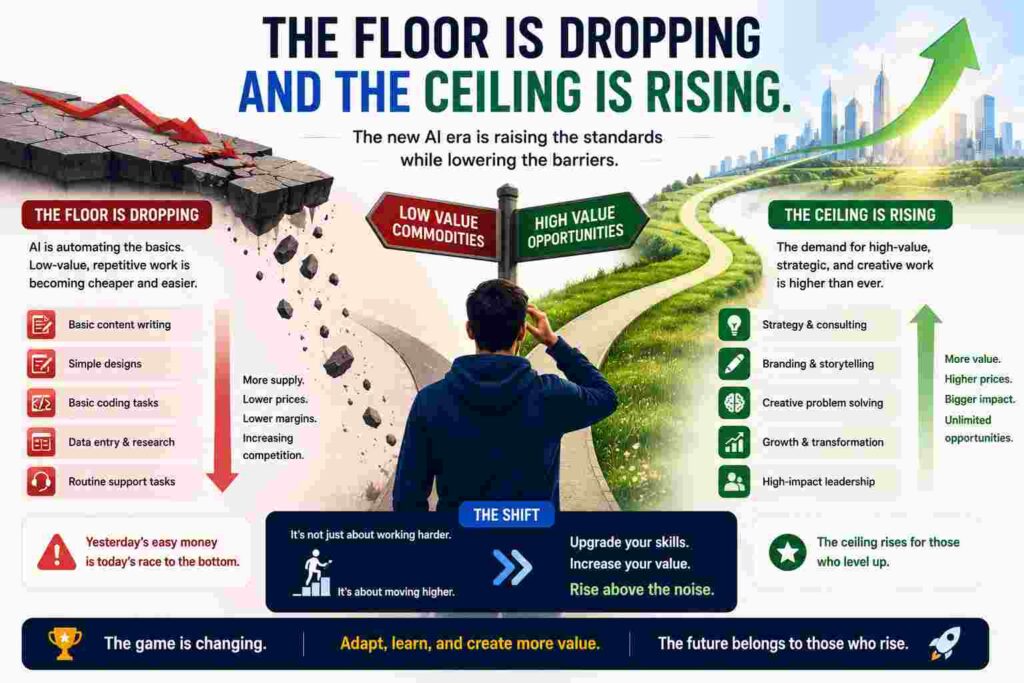
The floor is dropping and the ceiling is rising.
Generic, commoditized work is getting cheaper or disappearing. Work that requires genuine expertise, established trust, complex judgment, and deep client relationships is becoming more valuable. The middle — competent but undifferentiated generalist work — is where the real squeeze is happening.
Clients are learning what AI cannot do.
There was an initial wave of clients who cancelled freelancer relationships to try AI tools. Some of them are quietly coming back, having discovered that the time required to prompt, edit, fact-check, and reshape AI output into something actually usable was more than they expected. Others have stayed with AI for their lower-stakes needs and come back to human freelancers for work that genuinely matters to them.
New categories of work are opening up.
AI implementation consulting, prompt engineering, AI tool training, AI-assisted content strategy — categories that barely existed two years ago are now generating real income for freelancers who positioned themselves early. The technology is creating new needs at the same time it is automating old ones.
Quality differentiation is sharper than ever.
When mediocre work can be produced by anyone with a free ChatGPT account, what separates a working freelancer from irrelevance is the quality gap between their output and the AI baseline. That gap needs to be real, visible, and consistently demonstrated. Freelancers who close that gap lose their reason to exist. Freelancers who expand it become increasingly valuable.
The Freelancing Categories Holding Strong
Based on what I have watched closely and experienced personally, here are the areas where freelancers are not only surviving but in many cases thriving.
Strategic consulting and advisory work. Clients pay for judgment, perspective, and the ability to ask the right questions as much as for execution. AI cannot replace a consultant who understands your specific business, your industry history, your stakeholders, and your actual constraints.
Highly specialized technical writing. Medical, legal, financial, and regulatory content where accuracy is non-negotiable and errors have real consequences. The liability risk of relying on AI for this work keeps demand for qualified human experts strong.
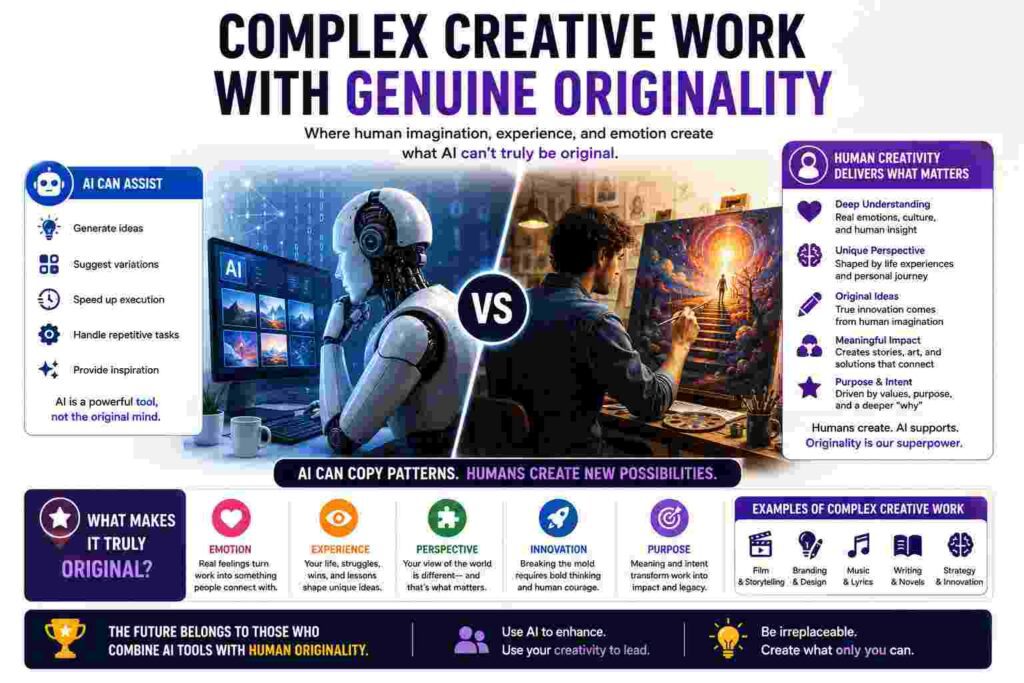
Complex creative work with genuine originality. Brand strategy, creative direction, narrative development for campaigns, copywriting that requires deep brand immersion and audience understanding — the kind of work where a generic output is not just insufficient but actively harmful to the client.
Research and investigation. Journalists, market researchers, user experience researchers — anyone whose value comes from finding things out through real human interactions, source relationships, and investigative judgment rather than synthesizing existing information.
High-stakes client-facing work. Anything where the relationship itself is part of the value — account management, client strategy, executive communications coaching. Clients do not want AI in the room for conversations that matter.
Building and maintaining AI systems for others. Freelancers who have learned to implement, maintain, and optimize AI tools for business clients have created entirely new revenue streams from the very technology some people feared would eliminate them.
Step by Step: How to Make Your Freelance Work AI-Proof
This is not about hiding from AI or pretending it is going away. It is about deliberately positioning yourself in the categories of work where human expertise maintains its value.
Step 1: Audit your current services honestly
Write down every service you offer and every task within each service. For each one, ask yourself honestly: could a client get a comparable result from a well-prompted AI tool? If the answer is yes for most of your work, you have a positioning problem worth addressing now rather than later.
Step 2: Identify your genuine expertise
Not just what you do but what you know, who you know, what you have seen across multiple client situations, and what judgment you bring that a first-time AI user could not replicate. This is your actual competitive advantage. Get specific about it and make sure it is visible in how you present yourself.
Step 3: Move upmarket deliberately
The squeeze is happening in the middle. Moving upmarket means specializing more deeply, serving clients for whom quality genuinely matters and who have the budget to pay for it, and packaging your services around outcomes and expertise rather than deliverables and hours.
Step 4: Learn AI tools well enough to use them in your work
The freelancers most at risk are the ones who refuse to engage with AI tools at all. Using AI to work faster and at higher quality while charging for your expertise and judgment is not selling out — it is staying competitive. Being the person who knows how to use these tools intelligently is itself a differentiator.
Step 5: Build client relationships that go beyond transactions
The freelancers who got cancelled were often in purely transactional relationships with clients who had no particular attachment to them as individuals. Clients who trust you personally, who know your communication style, who have seen you solve unexpected problems, who think of you as a partner rather than a vendor — those relationships are much stickier when AI presents itself as a cheaper alternative.
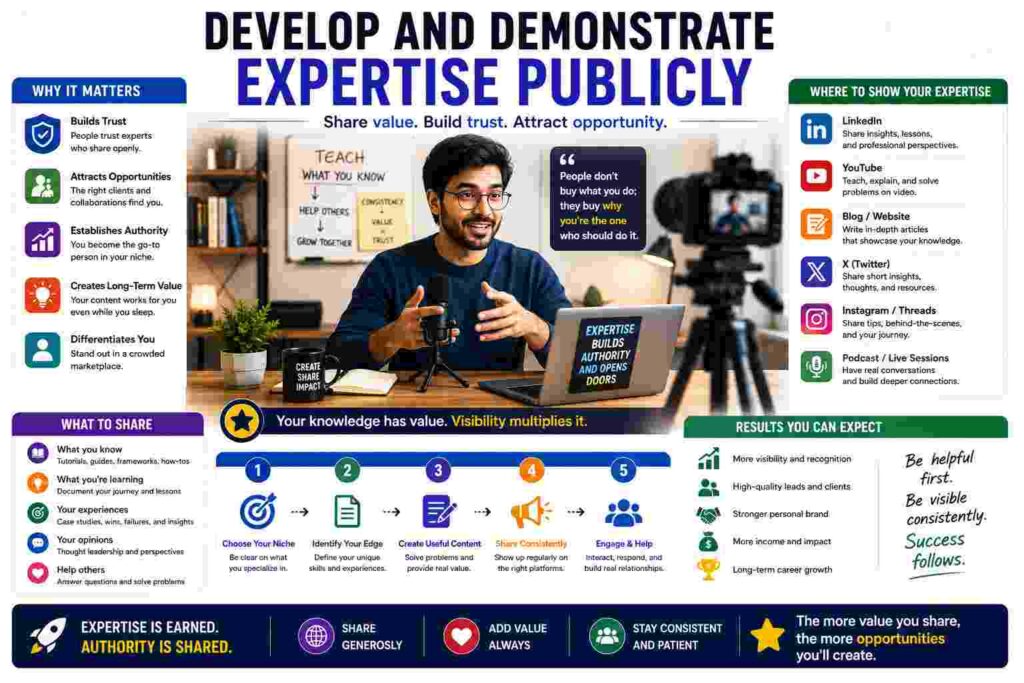
Step 6: Develop and demonstrate expertise publicly
Write about what you know. Speak at events. Contribute to industry conversations. Have visible opinions based on real experience. The freelancers who are hardest to replace are often the ones whose expertise is publicly established — who clients can find evidence of before even reaching out.
Mistakes That Are Making the Situation Worse for Some Freelancers
Refusing to use AI tools out of principle. This is understandable emotionally but strategically self-defeating. Not using tools that your competitors are using is not a moral stance — it is a competitive handicap.
Staying in commoditized categories without adapting. If your primary income is coming from the exact categories of work most affected by AI automation and you have not started moving, the time to move is now rather than when the options narrow further.
Competing on price with AI. You cannot win a race to the bottom against tools that cost a few dollars a month. The only winning move is competing on a dimension where price is not the primary factor — expertise, trust, complexity, accountability.
Panicking into bad decisions. I have watched freelancers dramatically underprice their work out of fear, take on clients who are clearly trying to use them as cheap AI supervisors, or pivot chaotically into categories they have no expertise in. Fear-driven decisions rarely improve the situation.
Treating this as a temporary problem that will resolve itself. The freelancers doing best right now are the ones who accepted that the landscape has permanently changed and made deliberate choices accordingly rather than waiting for things to go back to the way they were.
What I Actually Think When I Am Being Completely Honest
AI is a genuine disruption to freelancing. It is not an extinction event for freelancers who are willing to be honest about what is happening and deliberate about their response to it.
The work that is going away was always somewhat fragile — undifferentiated, easily replicated, dependent on volume rather than expertise. Its loss, while real and painful for people who depended on it, was not creating the most sustainable freelance careers anyway.
The work that is staying and growing is work that was always built on something more durable — genuine expertise, established trust, complex judgment, and outcomes that clients genuinely care about getting right.
The freelancers who will look back on this period as the thing that forced them to become significantly better at what they do are probably sitting somewhere right now feeling exactly the fear I felt reading that forum post.
That fear, taken seriously and acted on deliberately rather than catastrophized or dismissed, is actually useful.
Use it.
This article reflects personal observations and research and does not constitute career or financial advice. Freelancing outcomes vary significantly based on niche, skills, market positioning, and individual circumstances.