Introduction
Last year, I was a basic freelance writer making $15 per article. Then I started using AI tools — not to replace my work, but to do it faster and better. Within three months, I was charging $150 for the same article. I didn’t write a single line of code. Here’s exactly what worked.
Let me be honest with you first. Every time I saw someone on Twitter saying “Make $10,000/month with AI,” I rolled my eyes. Most of those posts are just selling courses. What I’m sharing here are things I’ve actually tested — or watched real people do seriously. Some worked great. Some were total duds. I’ll tell you which is which.
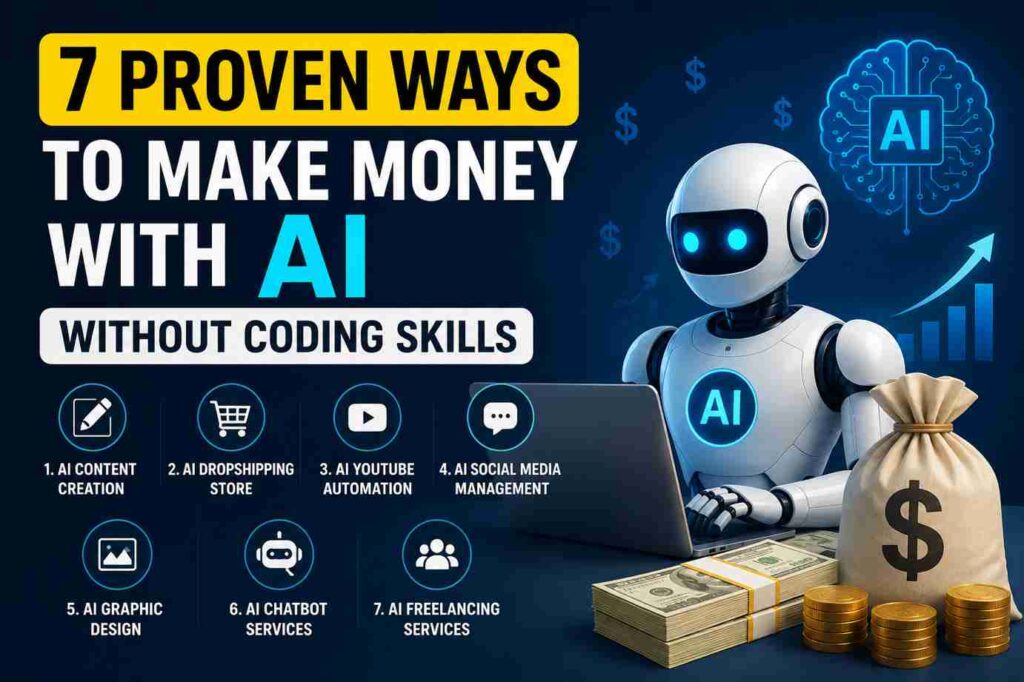
1. AI-Assisted Content Writing and Ghostwriting
This is where I personally started, so I’ll give you the real version.
AI doesn’t write great content on its own. It writes fast, average content. Your job is to be the editor — the person who adds real experience, fixes the tone, and makes it actually good.
What changed for me was using ChatGPT or Claude as a first-draft tool. I’d spend 10 minutes prompting, get a rough structure, then spend 40 minutes making it genuinely useful. Clients started getting polished 2,000-word articles in 2–3 hours instead of 6–8. They were happy. I was earning more per hour than ever before.
The real money is in niches. Healthcare, legal, SaaS, finance — these clients pay $0.15 to $0.30 per word because they need accuracy, not just filler. If you already know a subject, combine that knowledge with AI and you’re immediately ahead of generic writers.
How to start: Pick one niche you know well. Offer three sample articles on Upwork or through cold outreach. Use AI for drafts, your brain for quality control.
Tools to use: ChatGPT, Claude, Jasper, Surfer SEO, Upwork
2. Selling AI-Generated Art and Digital Products
A friend of mine opened an Etsy shop selling AI-generated wall art prints. She made $900 her first month. By month four, she was earning $3,200 — working about 5 hours a week. She uses Midjourney to create the art, Canva to format it, and Etsy to sell digital downloads.
The catch? The market got crowded fast. Generic AI art now competes with thousands of other shops. What still works is being specific — nursery prints with custom names, art for specific fandoms, hyper-niche styles. The more specific you go, the less competition you face.
You can also upload AI-generated patterns, vectors, and textures to Adobe Stock, Shutterstock, or Creative Fabrica. These pay small amounts per sale but are fully passive once uploaded.
Mistake to avoid: Don’t upload generic landscape art to stock sites and expect passive income. Research what commercial buyers actually need — seamless patterns, icons, mockups. That’s where the sales are.
Tools to use: Midjourney, DALL-E 3, Adobe Firefly, Canva, Etsy

3. AI Video Creation for YouTube and Clients
Faceless YouTube channels have been around for years, but AI made them much easier to produce. Tools like Pictory and InVideo let you turn a written script into a full video with stock footage, voiceover, and captions — no camera, no editing experience needed.
I know someone running a personal finance YouTube channel this way. He writes scripts with AI help, runs them through Pictory, and uploads three times a week. He hit 10,000 subscribers in 8 months. Between AdSense and affiliate links, he earns around $1,400 a month — part-time.
The other angle is doing this for small businesses. Local restaurants, coaches, and real estate agents all want short videos for Instagram and TikTok but can’t afford a videographer. If you can deliver solid 60-second promotional videos for $100–$200 each, you have a real service.
How to start: Make 5 sample videos in a niche you enjoy. Use them as your portfolio. Then reach out to 20 small businesses in that niche and offer the first video free. Convert 1–2 into paying clients.
Tools to use: Pictory, InVideo AI, ElevenLabs, Opus Clip, CapCut
4. Prompt Engineering and AI Consulting
This one surprised me the most. “Prompt engineer” sounds technical but it’s genuinely not about coding. It’s about knowing how to talk to AI models so they give you useful, consistent results. And businesses are paying good money for this skill.
A consultant I follow charges $150 per hour to help marketing teams set up AI workflows. She builds custom prompt templates for their content, emails, and social posts. She teaches their team to use them. No code. Just clear thinking and communication.
You can also sell prompt packs on platforms like PromptBase or Gumroad. These sell for $3–$10 each, but a good pack of 50 prompts for a specific use case can easily sell 200 copies. That’s $600–$2,000 from one product you built once.
How to start: Pick one industry — e-commerce, real estate, or coaching. Build and test 30 genuinely useful prompts for that industry. Package them into a PDF or Notion doc. Sell for $15–$25.
Tools to use: PromptBase, Gumroad, Notion, Claude, LinkedIn

5. AI-Powered Social Media Management
Small business owners know they need to post on social media. They hate doing it and they don’t have time. Hiring a full agency costs $2,000–$5,000 per month, which is way out of reach for most of them.
What you can offer is a “done-for-you” social media package using AI tools to write content and schedule posts. Use ChatGPT or Claude to write captions, Canva’s AI features to create graphics, and Buffer or Later to publish everything. You’re the operator managing the AI pipeline for them.
Charging $400–$700 per month per client is very reasonable for this. With just 5 clients, that’s $2,000–$3,500 per month for roughly 20–25 hours of work.
Lesson learned the hard way: Don’t take on more clients than you can properly manage. Generic AI content is easy to spot and it hurts your client’s brand. You still need to understand their business and edit every single post.
Tools to use: Buffer, Canva AI, Later, ChatGPT, Hootsuite
6. Building and Monetizing an AI-Powered Newsletter
Newsletters are making a comeback, and AI makes them much more realistic to run solo. The model is simple — curate valuable information for a specific audience, build your list, then make money through sponsorships or paid subscriptions.
AI handles the drafting, summarizing, and formatting. Your job is curation, taste, and growing the audience. That human judgment is exactly what separates a newsletter worth reading from one that gets ignored.
A newsletter with 2,000 engaged subscribers in a business niche can realistically earn $500–$1,500 per month from a single sponsor. The Beehiiv platform is great for this — it has built-in AI tools, sponsor networks, and monetization features all in one place.
Realistic timeline: Expect 6–9 months before meaningful income. Focus on a niche you genuinely care about. Newsletters where the writer clearly doesn’t care about the topic die fast.
Tools to use: Beehiiv, Substack, Perplexity AI, Claude, ConvertKit
7. Teaching Others How to Use AI
Here’s the irony of the AI boom. Millions of people have heard that AI will change everything, but most have no idea how to actually use it for anything practical. There is a massive demand for people who can explain these tools clearly to non-technical professionals.
If you’ve spent a few months getting good at AI tools, you are already ahead of most business owners. You can run workshops, do one-on-one consulting, create online courses, or train company teams.
A 4-week cohort course priced at $297 with just 20 students is nearly $6,000. Once you build the course, you can run it again and again.
How to validate before building: Offer a single 90-minute paid workshop for $47–$97. If people pay and find it valuable, you’ve confirmed the demand. Then build the full course.
Tools to use: Maven, Teachable, Gumroad, Zoom, Notion
Mistakes That Actually Cost People Money
Chasing too many things at once. Content writing, art, a newsletter, and a YouTube channel — all at the same time. Nothing gets traction because nothing gets focus. Pick one thing for 90 days.
Relying 100% on AI output. AI gives you a starting point, not a finished product. The people earning well are adding real expertise and judgment on top. That’s what clients are paying for.
Underpricing to get started. There’s a difference between a discount for testimonials and chronic undercharging. You’ll attract difficult, low-paying clients. Charge what the work is actually worth.
Not treating it like a business. You still need a system — how you find clients, deliver work, invoice, and follow up. AI doesn’t fix the business side of running a business.

What This Actually Takes
None of these are “passive income from day one.” The writers making $3k a month spent six months building clients. The newsletters that monetize well spent a year growing a list. The AI art shops that work put serious research into what buyers actually want.
The real advantage of AI is that it compresses the time between having a skill and producing high-quality output. It doesn’t skip the part where you show up consistently, learn what the market wants, and get good at delivering it.
Start with the method that fits what you already know. A marketing background makes the social media path natural. A love of writing makes the newsletter or content route easier. The tools are similar for everyone — the expertise you add on top is where you stand out.
The window where AI skills give you a real head start is open right now. Start with one thing. Start this week.