About a year ago, a friend of mine quit his marketing job and told me he was starting an “AI agency.” I asked him what that meant exactly. He paused for a second and said, “Honestly, I’m still figuring that out — but I know businesses need this stuff and most of them have no idea where to start.”
Introduction
Twelve months later he has seven clients, two part-time contractors, and is pulling in around $18,000 a month. He figured it out.
I watched that whole journey up close — the early confusion, the wrong clients, the pricing disasters, the slow build that eventually clicked. Combined with my own experience helping businesses adopt AI tools, I want to give you the most honest, practical breakdown of how to actually start an AI agency from scratch — not the YouTube version where everything looks easy and profitable from day one.
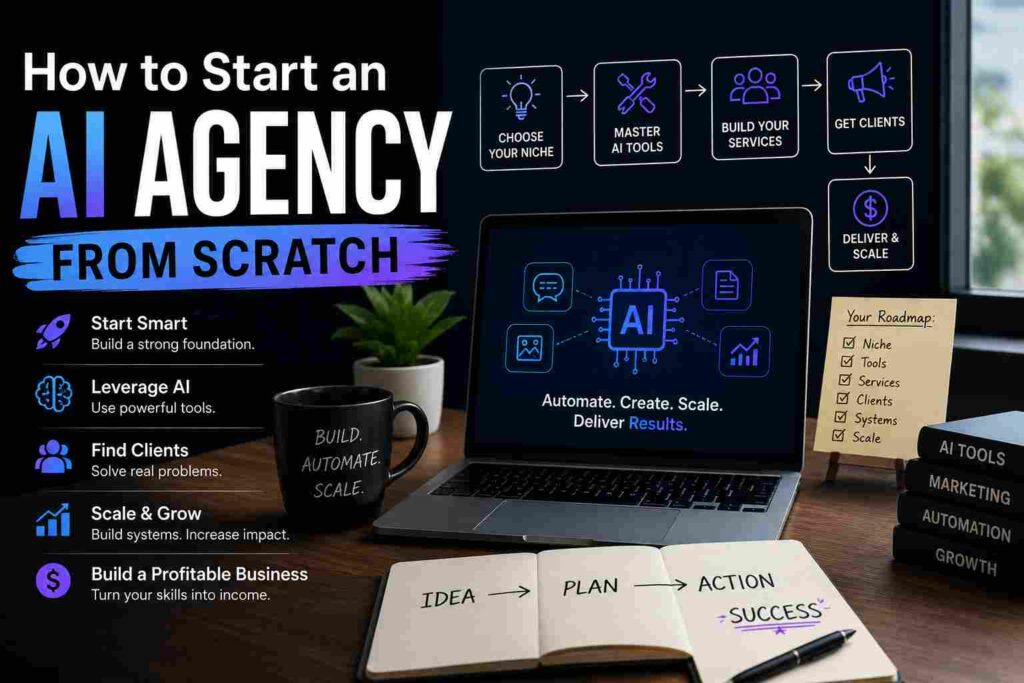
First, What Is an AI Agency Actually?
Before anything else, let’s get clear on this because there’s a lot of confusion.
An AI agency helps businesses use artificial intelligence tools to solve real problems — saving time, cutting costs, improving marketing, automating repetitive tasks, or generating content at scale. You’re not building AI from scratch. You’re not a software company. You’re more like a specialist contractor who knows how to find, set up, and manage AI tools that most business owners don’t have time to learn themselves.
Think of it like a social media agency, but instead of managing Instagram accounts, you’re managing AI systems and workflows. The barrier to entry is lower than people think. The bar for doing it well is higher than most people expect.
Step 1: Pick a Niche Before You Do Anything Else
This is the step most people skip because they want to help everyone and make money fast. That thinking will slow you down, not speed you up.
When my friend started, he tried positioning himself as a general “AI consultant for businesses.” His pitch was vague, his outreach was scattered, and his first two months were dry. Then he narrowed down to one niche — real estate agencies — and everything changed. Suddenly he knew exactly what problems they had, what tools solved those problems, and how to talk about it in language they understood.
Niche selection is everything at the start. Here are some niches that are genuinely hungry for AI help right now:
Local service businesses — dentists, law firms, plumbers, salons. They need AI for appointment booking, follow-up emails, review management, and local SEO content.
E-commerce stores — product descriptions at scale, customer service chatbots, email marketing automation.
Marketing agencies — many agencies are desperate to add AI capabilities for their own clients but don’t have the in-house knowledge.
Coaches and consultants — content creation, lead generation, automated onboarding systems.
Real estate — listing descriptions, lead follow-up sequences, market report generation.
Pick one. Get really good at solving their specific problems. Expand later.
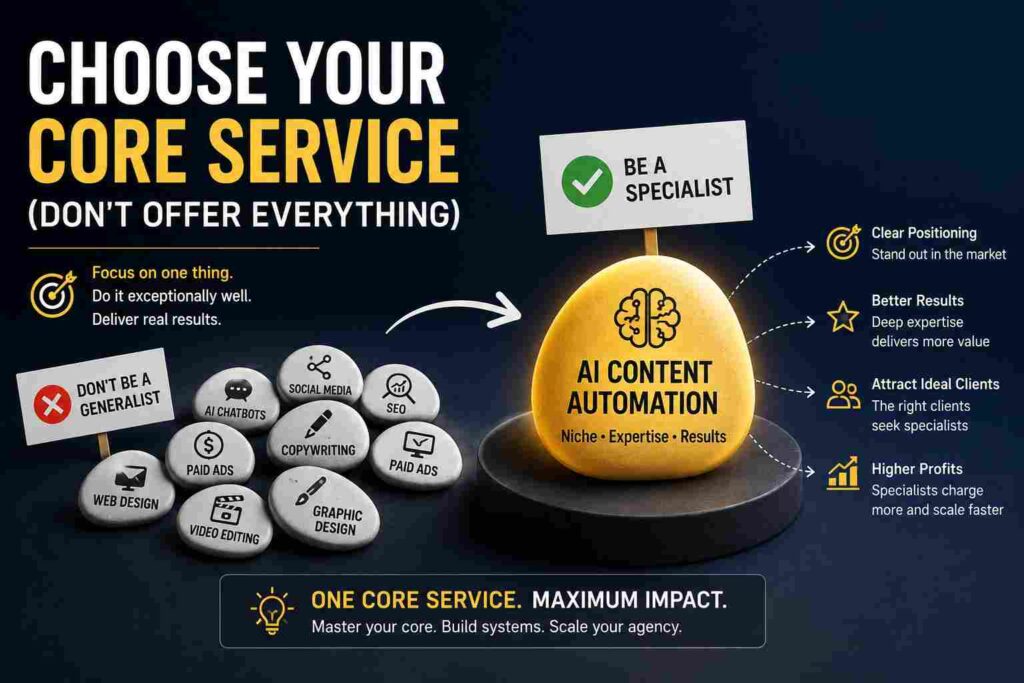
Step 2: Choose Your Core Service (Don’t Offer Everything)
Once you have a niche, decide what you’re actually selling. The most common AI agency services right now are:
AI content creation — blog posts, social media content, email sequences, product descriptions. Generated with AI, edited and managed by you.
AI chatbot setup — building and deploying customer service or lead generation chatbots for business websites. Tools like Voiceflow, ManyChat, and Botpress make this possible without deep technical skills.
AI automation workflows — connecting tools so that repetitive tasks happen automatically. Using platforms like Make (formerly Integromat) or Zapier with AI integrations to automate things like lead follow-ups, data entry, report generation.
AI social media management — running clients’ social channels using AI for content generation, scheduling, and basic engagement.
AI SEO services — using AI tools to produce optimized content, conduct keyword research, and scale blog production for clients.
Start with one service. The agencies that struggle are the ones that say yes to every type of project in the beginning. You end up doing mediocre work across five different things instead of excellent work in one area.
Step 3: Learn the Tools Properly Before Selling
This sounds obvious but plenty of people skip it. They sell a service they haven’t fully figured out yet and then scramble to deliver.
Spend four to six weeks actually getting good at the tools relevant to your chosen service. If you’re doing AI content, get deeply comfortable with ChatGPT, Claude, and a tool like Surfer SEO or Jasper. If you’re building chatbots, build three or four practice bots on Voiceflow before you take a paying client. If you’re doing automation, build actual workflows in Make or Zapier and break them and fix them until you understand how they work.
The good news is that none of these tools require coding. Most have tutorials, active communities, and YouTube channels dedicated to them. You can get genuinely competent in most of them within a month of consistent practice.
Also build two or three case study projects during this phase — even if they’re hypothetical or done for free for a friend’s business. You’ll need something to show people.
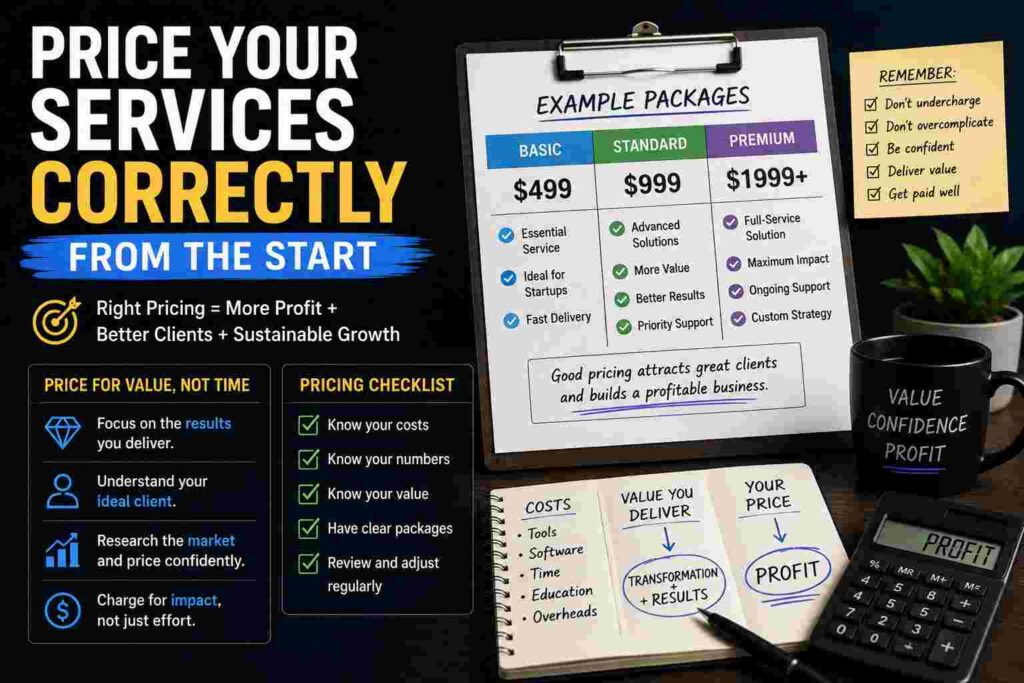
Step 4: Price Your Services Correctly From the Start
Pricing is where most new AI agencies make their first big mistake. They either charge too little because they lack confidence, or they try to charge enterprise rates with no track record.
Here’s a realistic pricing framework for a brand new AI agency:
Starter phase (first 2 clients): Offer discounted rates in exchange for testimonials and case study rights. Not free — discounted. Something like $300 to $500 per month for a service that will eventually be $1,000 to $1,500. Free work attracts clients who don’t value what you do.
Growth phase (clients 3 through 8): Charge $800 to $2,000 per month depending on the service and scope. This is where most small AI agencies operate comfortably.
Scale phase: Once you have strong case studies and a clear process, $2,000 to $5,000 per month per client is realistic for comprehensive AI service packages.
One thing that helped my friend enormously was switching from hourly pricing to monthly retainers early on. Hourly makes clients nervous about every call and email. A flat monthly retainer means they know exactly what they’re paying and you have predictable income.
Step 5: Get Your First Client
This is the part everyone wants a magic answer for. There isn’t one. But there are approaches that work faster than others.
Warm outreach first. Before cold outreach to strangers, go through your existing network. Former colleagues, friends who run businesses, family contacts. Tell them what you’re doing. Ask if they know anyone who might need help. Most first clients come through someone you already know.
LinkedIn is genuinely useful. Start posting content about AI — what you’re learning, what problems it solves, short tips for specific industries. You’re not trying to go viral. You’re just building a visible track record of knowledge. Direct message people in your target niche with a specific observation about their business and how AI could help. Keep it short and personal.
Local business outreach. If you’ve niched into local businesses, walk in or call. Most local business owners have heard about AI but haven’t talked to a real person who can explain it clearly. Being the first person to have that conversation face to face gives you a huge advantage over some email from a stranger.
Offer a free audit. Put together a 20-minute “AI opportunity audit” where you look at a business’s current operations and identify three specific ways AI could save them time or money. This is low commitment for them and gives you a natural way into a paid conversation.
Step 6: Deliver, Document, and Systematize
The difference between an agency that grows and one that stays stuck at two clients is systems.
From your very first client, document everything. How you onboard them. How you build their deliverables. How you report results. How you handle revisions. Every repeatable process should be written down in a simple Notion doc or Google Doc.
This does two things. First, it forces you to get consistent and professional. Second, when you’re ready to bring on a contractor or hire help, you have something to hand them instead of carrying everything in your head.
Use a project management tool from day one. Notion, Trello, or ClickUp all work fine. Have a clear place where every client project lives, with tasks, deadlines, and status visible.
Reporting matters more than most new agency owners realize. Send clients a simple monthly report showing what was done and what results it produced. Even if the results are modest at first, showing that you’re tracking and thinking about outcomes builds enormous trust.
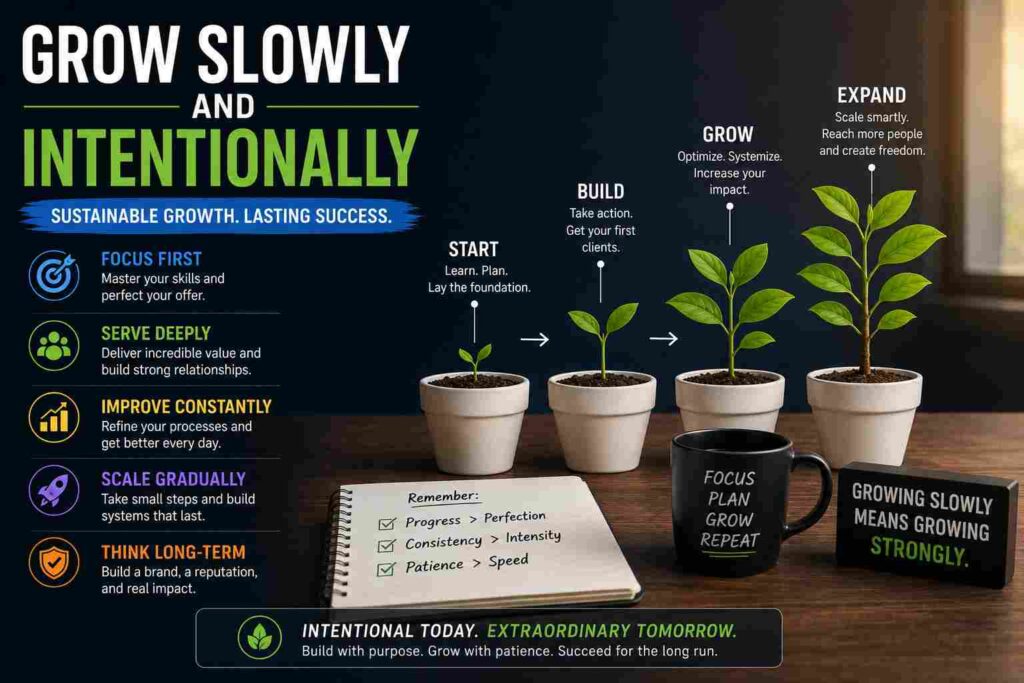
Step 7: Grow Slowly and Intentionally
The temptation once you have a few clients and some income coming in is to scale up fast — hire a team, take on more clients, expand services. Resist this in the early months.
Grow your client base before you grow your team. Make sure your core service is truly dialed in and clients are genuinely happy before you start adding complexity. One unhappy client who leaves and tells people is worth losing three potential clients.
When you do start bringing people in, start with freelancers on a per-project basis before committing to full hires. Upwork and Contra are good places to find reliable AI-skilled contractors. Test a few people on small projects before trusting them with client work.
Mistakes That Are Worth Avoiding
Taking clients outside your niche too early. Every time you say yes to a project that doesn’t fit your focus, you dilute your expertise and slow down your systems-building.
Underpromising and then overdelivering sounds good but creates scope creep. Be clear about exactly what’s included in your service from the start. Put it in writing.
Not having a contract. Even a simple one-page agreement covering scope, payment terms, and revision limits protects you and signals professionalism. Use a free template from Bonsai or AND.CO.
Chasing every new AI tool. New tools launch every week and it’s easy to spend more time learning tools than actually serving clients. Stick to your core stack until you have a genuine reason to switch.
Measuring success only in revenue. Early on, testimonials, referrals, and case studies are worth as much as the monthly fee. A glowing testimonial from your first client will close your next five.
The Reality Nobody Talks About
Starting an AI agency is genuinely exciting right now because the timing is good. Businesses are aware that AI exists and that they probably need it — but most are confused and overwhelmed by it. That gap between awareness and implementation is exactly where an AI agency lives.
But it’s still a service business. That means the same things that make any service business succeed apply here too — reliability, communication, actually solving problems, showing up consistently.
The AI part gives you leverage. The business fundamentals are what make it sustainable.
My friend didn’t hit $18,000 a month because he had the best AI tools or the smartest strategy. He got there because he picked a niche, got really good at a specific set of problems, treated his clients well, and kept showing up every month.
That part hasn’t changed and probably won’t.