The week I decided to start my own service business, I had exactly $47 in my checking account.
Not $47 after bills. $47 total.
I’d just left a job that wasn’t working out, had no savings cushion, and genuinely didn’t know what I was going to do next. Starting a business felt like something people with money did — you needed a website, a logo, maybe some ads, a laptop that wasn’t six years old.
Within three weeks, using nothing but free AI tools and a phone I already owned, I had my first paying client. No investment. No fancy setup. No business cards. Just a service someone needed, delivered well, found through channels that cost nothing to use.
This is exactly how I did it — and how you can too.

The Idea Most People Get Backwards
When most people think about starting a business, they think about the product first. What am I going to sell? What’s my niche? What should I call it?
That’s actually the last thing you should figure out.
The first thing is: what can you do right now that someone else would pay you to do?
It doesn’t have to be fancy. It doesn’t have to be your passion. It just needs to be useful and something you can deliver without buying anything.
AI tools slot in here perfectly because they let you do things at a professional level that used to require either expensive software or years of practice. Writing, editing, research, social media, customer support scripts, email sequences, basic automation — all of this is now accessible to anyone with a free ChatGPT account and a few hours to learn the ropes.
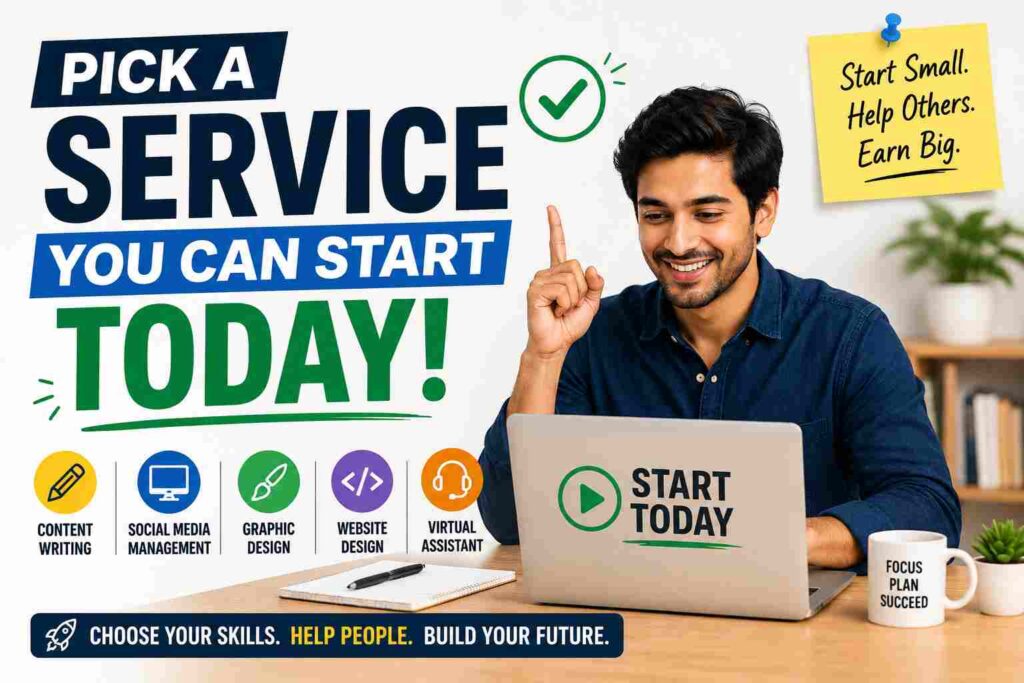
Step 1: Pick a Service You Can Start Today
Here’s a short list of service businesses that cost literally nothing to start and work well when you’re using AI as your behind-the-scenes assistant:
Email newsletter writing — Local businesses, coaches, and e-commerce stores all need consistent email content but rarely have time to write it. You write it, AI helps you do it faster and better.
Social media caption writing — Every business with an Instagram or Facebook page needs captions. Most owners hate writing them or run out of ideas after a week.
Meeting notes and summaries — Busy professionals pay for someone to take their call notes, transcribe them, and turn them into clean action items. Otter.ai does most of the heavy lifting.
FAQ and help content writing — Small businesses need FAQ pages, onboarding docs, and support scripts. You write them, AI helps you organize and polish them.
Job listing rewrites — Bad job listings get bad candidates. Companies pay to have them rewritten. ChatGPT is excellent at restructuring these.
Local SEO content — Small local businesses need blog posts and location pages but have no idea where to start. You handle it with AI-assisted writing and light research.
Pick one. Just one. The mistake most beginners make is trying to offer five services at once and ending up looking like they’re not really good at any of them.
Step 2: Set Up Your “Office” for Free
You don’t need a website on day one. I know that feels counterintuitive, but a website without clients is just an expensive hobby.
Here’s the free setup that actually works:
ChatGPT (free plan) — Your main assistant for writing, editing, brainstorming, and research. The free version is more than enough to start.
Canva (free plan) — For any simple graphics, a basic one-page portfolio PDF, or a service menu you can share over email or WhatsApp.
Google Docs — For delivering work to clients. Clean, professional, shareable. No email attachment back-and-forth.
Otter.ai (free plan) — If your service involves meetings or calls, Otter transcribes them automatically. The free tier gives you 300 minutes a month which is plenty to start.
LinkedIn (free) — Your actual storefront for now. A well-filled LinkedIn profile with a clear headline is better than most basic websites I’ve seen.
WhatsApp or Gmail — For client communication. That’s it.
Total cost: $0.
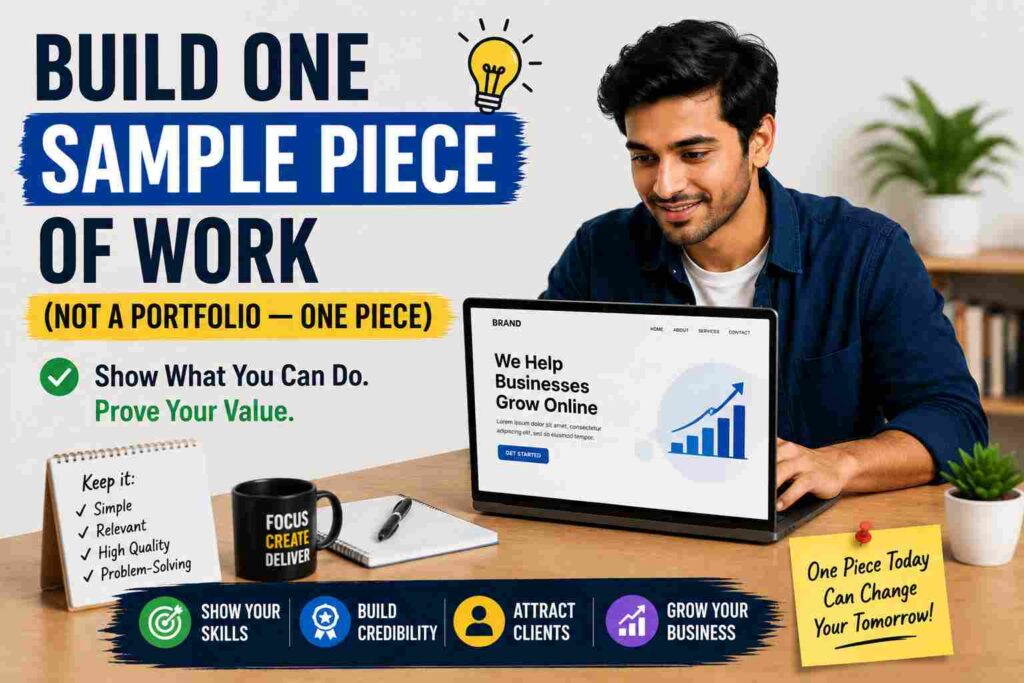
Step 3: Build One Sample Piece of Work (Not a Portfolio — One Piece)
People will ask to see your work before hiring you. That’s fair. But you don’t need ten samples. You need one really good one.
Pick a fake or real business in your target niche and create a sample piece of whatever you’re offering.
If you’re doing social media captions — write a week’s worth of captions for a local coffee shop (real or made up).
If you’re doing email newsletters — write one full email as if you’re working for a fitness coach.
If you’re doing FAQ content — write a clean FAQ page for a made-up plumbing company.
Use ChatGPT to help you draft it, then edit it heavily in your own voice. Make it genuinely good. This one piece of work is going to do a lot of heavy lifting for you in the early days.
Save it as a Google Doc or a PDF via Canva, and keep the link ready to share the moment someone asks.
Step 4: Find Your First Client Without Spending a Cent
This is where most people freeze. They think finding clients requires ads, a big following, or some kind of credibility they don’t have yet.
It doesn’t. Here’s where I actually found my first three clients:
Facebook Groups — Almost every industry has active Facebook groups. Local business groups, freelancer groups, niche communities. Search for your target client type, join the group, genuinely engage for a few days, then post something helpful — not a sales pitch. Something like: “I’ve been helping small businesses clean up their email lists and improve open rates — happy to share what’s been working if anyone’s interested.” DMs will follow.
LinkedIn outreach — Find 10 businesses in your niche. Look at their LinkedIn page. If their content looks inconsistent, outdated, or nonexistent, that’s your opening. Send a short, friendly message — not a pitch, just an observation and a question. Something like: “Hey, I noticed your last LinkedIn post was from four months ago — is content something you’ve been wanting to get back to?” Conversation starter, not a cold sell.
Local businesses in person or on WhatsApp — Walk into a coffee shop, hair salon, or small store you already visit. Tell them what you do in one sentence. Ask if they’ve been struggling with it. You’d be surprised how many small business owners say yes immediately.
Reddit — Subreddits like r/entrepreneur, r/smallbusiness, and niche-specific communities often have people asking for help with exactly the services you’re offering. Answer questions genuinely, build some goodwill, mention your service only when it’s directly relevant.
Step 5: Deliver the Work Using AI as Your Assistant
Once you land that first client, here’s how AI tools actually fit into the delivery side:
For writing work: Give ChatGPT the client’s tone, audience, and any examples of their existing content. Ask it to draft a version. Then rewrite it yourself — this is crucial. The AI draft should save you time, not replace your judgment.
For research-heavy work: Use Perplexity AI to quickly pull together background info on the client’s industry. This helps you sound like an expert even when you’re still learning a niche.
For anything involving calls: Record and transcribe with Otter. Use ChatGPT to turn the transcript into a clean summary with action items. Clients love getting a professional follow-up doc after every call.
For turnaround speed: This is where AI genuinely changes things. Work that used to take a skilled freelancer four hours now takes two. That means you can take on more clients, deliver faster, or just reclaim your time.

Mistakes I Made That You Can Skip
Undercharging because I felt like an imposter. I charged $50 for something I should have charged $150 for because I was scared the client would say no. They didn’t even negotiate. Start at a reasonable rate and trust that good work speaks for itself.
Trying to look bigger than I was. I wasted time writing a “company overview” and coming up with a business name before I had a single client. Nobody cares about your brand name when they’re deciding whether to hire you. They care about whether you can solve their problem.
Saying yes to every type of project. A local bakery asked me to help them with their bookkeeping because they knew I was “good with computers.” I said yes. I was terrible at it. Stick to your one service until you’re genuinely good at it and have a case study to show for it.
Not asking for a testimonial after the first job. This one stings a little. My first client was thrilled with the work and I just… never asked for a written testimonial. I was too awkward about it. Now I ask every single time, right after the client says something positive. “Could I grab that as a quick testimonial? It really helps me out.” Most people say yes without hesitation.
What “No Startup Cost” Actually Means Long-Term
Eventually, you might want to upgrade to a paid ChatGPT plan, buy a proper domain, or invest in a tool that makes your workflow smoother. That’s totally fine — by then, you’ll have revenue to cover it.
But the point is you don’t need any of that on day one. The business exists because someone is willing to pay you to solve a problem. Everything else is just infrastructure that comes later.
The AI tools are there to make you faster, better, and more confident — not to replace the part where you actually show up and do good work for someone.
That part is still yours.
The barrier to starting isn’t money. It never really was. It’s the story we tell ourselves about what’s required before we’re “ready.” AI tools have quietly removed most of the practical obstacles — the skills gap, the time gap, the quality gap.
What’s left is just deciding to start.
This weekend is as good a time as any.